

Built for the Boss, Not the Users: A Common Mistake in Internal Systems
The system passed every demo. Management signed off. But the people who use it daily never opened it again.
Heartbyte Team
Engineering & Strategy
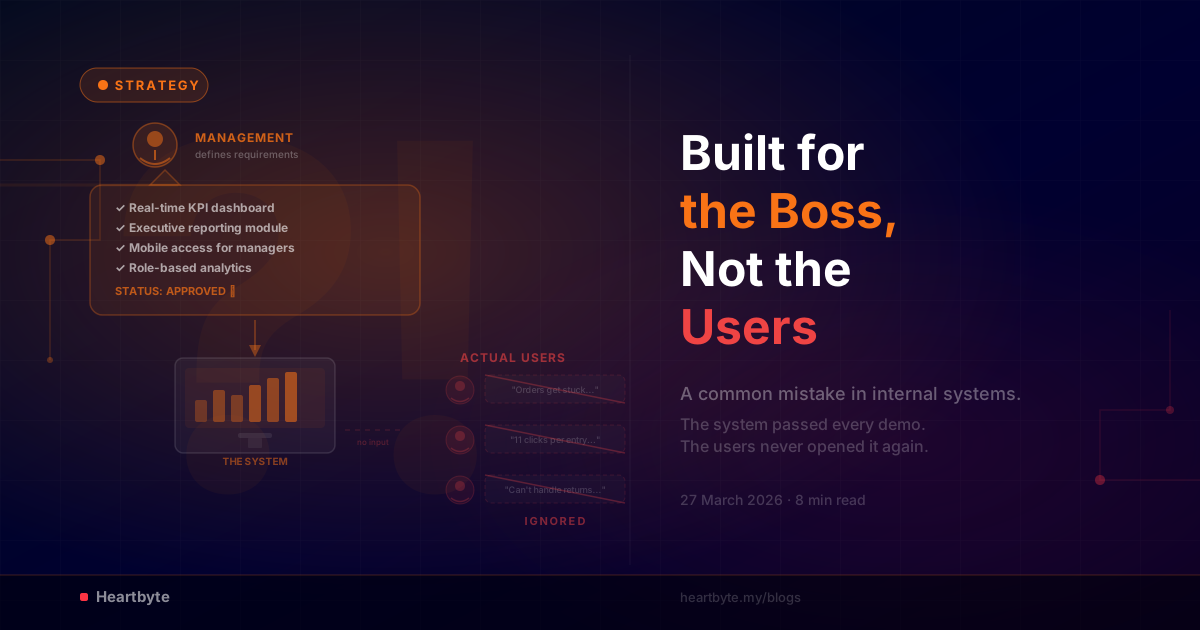
This happens in companies every month. A new internal system gets rolled out. Management is thrilled. The vendor delivered on time and the demo looked great. There's a dashboard with charts, a report generator, role-based access, everything the spec asked for.
Three months later, the operations team is still using Excel. The warehouse team built their own workaround in Google Sheets. Customer service went back to their old way of doing things. The system that cost six figures is a ghost town. The only people who open it are the two managers who approved it, to pull the monthly report that nobody reads.
What went wrong? The system was built for the boss. Not for the users.
Let the Users Speak for Their Own Problems
Most internal system projects fail for one reason: the people who write the requirements are not the people who will use the system. A department head describes what they think the team needs. A project manager turns that into a spec. A vendor builds what's in the spec. Nobody ever sits down with the actual users and asks what their day is really like and where it hurts.
This is why most internal tools fail. The manager sees the workflow from far above. They know what goes in and what comes out. But they don't know the twenty small decisions, exceptions, and workarounds that happen in between. They don't know the data entry clerk spends 40 minutes every morning copying data from one system to another because the two don't talk to each other. They don't know the sales team ignores the CRM because it takes 11 clicks to log one customer call.
The people doing the work know what's broken. They've been living with it every day. But nobody asks them, because the budget holder already "knows" what's needed.
When you let users speak for their own problems, you get a very different set of requirements. Instead of "we need a dashboard with real-time KPIs," you get "I need to see which orders are stuck in approval so I can chase them before the customer calls." Instead of "we need automated reporting," you get "I spend three hours every Friday combining data from four spreadsheets by hand. Can we just make that stop?"
These are not the same requirements. The first set builds a system that impresses the board. The second one builds a system people actually use.
Two ways to gather requirements:
Top-down (management-driven):
"We need a unified platform with role-based dashboards, automated workflows, real-time analytics, and mobile access for management oversight."
Bottom-up (user-driven):
"The delivery team needs to mark orders as dispatched from their phone. Finance needs purchase orders to auto-populate from approved quotations. The warehouse needs a scan-to-confirm system so we stop shipping wrong items."
The bottom-up approach gives you uglier requirements. They're messy, specific, and sometimes they don't agree with each other. But they're real. A system built on real needs gets used. A system built on a management wishlist only ever gets demoed.
The Dashboard Delusion: When the System Serves the Boardroom
We see the same thing in almost every failed internal system: the most polished part is the dashboard. It's beautiful. Real-time charts, colour-coded KPIs, drill-down reports, export to PDF. The kind of thing that makes a great screenshot in a vendor proposal.
Meanwhile, the data entry screen that 50 people use eight hours a day is a nightmare. Too many fields. No defaults. No keyboard shortcuts. No way to handle the exceptions that come up all the time. The form was designed by someone who's never had to fill it in 200 times a day.
A dashboard is only as good as the data feeding it. If the people entering data hate the system, your beautiful charts are built on garbage.
This happens because the system was built to serve the person who approved the budget, not the person who has to use it. The boss wants visibility. The user wants to get the job done fast. When those two goals clash, the boss usually wins. And the project loses.
The irony stings. Management wanted better visibility and got a system nobody uses. Now they can see less than before, because the team went back to their spreadsheets, which management can't see at all.
The Documentation Trap: Writing to Cover Your Back, Not to Guide Development
Something doesn't get said enough in this industry. Most project documentation is written to keep management happy, not to guide the build.
Custom software gets built in cycles. You build, you test with real users, you learn what doesn't work, you fix it, you build again. That's not a flaw in the process. That's the process. Software is not a bridge. You can't draw up every detail upfront and then "build to spec." The spec will be wrong, because you're trying to describe a system that doesn't exist yet, for workflows that will change the moment it goes live.
The real software development cycle:
This isn't a failure of planning. This is the plan.
But management teams often don't see it that way. They want a document. A complete signed-off spec that describes every screen, every field, every workflow before a single line of code is written. Not because it helps the dev team, but because it makes management feel in control. Something to point to, something to hold the vendor to.
The problem is that by the time the system is delivered, half or more of that document is wrong. Not because anyone lied or was bad at their job, but because things changed. Users found needs they didn't know they had. Edge cases turned up. The business shifted. What was written down six months ago no longer matches what the business needs today.
"We spent three months writing the perfect spec. By the time development started, the team had already reorganised and half the workflows had changed. The document became a weapon — not a guide."
Nobody wants to admit what that carefully written document turns into: a weapon. Not against the vendor. Against you. When the delivered system doesn't match reality, and it won't, the document becomes the proof. "But the spec said X." "But you signed off on Y." Every gap between the document and reality turns into a change request, a blame game, or a contract fight.
The document was never written by the users. It was written to please management. And in the end it helped neither.
What Gets Built When Nobody Listens to the Floor
When internal systems are built top-down, with management deciding, the vendor building, and users just told to deal with it, you get the same failures every time:
Features nobody asked for
The system has a beautiful approval workflow with four escalation levels, but the team only has two people who approve things. It has a built-in messaging module, but everyone uses WhatsApp. Stuff that looked good in the proposal but solves problems that don't exist on the ground.
Missing the 20% that matters most
The system handles the standard flow perfectly. But 30% of real transactions are exceptions: partial returns, split invoices, manual overrides, backdated entries. These weren't in the spec because management doesn't deal with them. The users do. Without a way to handle exceptions, the system is useless for real work.
Workflows that fight the user
The system forces a process that looks logical on paper but doesn't match how work actually flows. Users have to enter data in an order that makes sense to the database, not to their job. They click through required fields that don't apply to them. They can't skip steps that don't matter. The system gets in the way instead of helping.
Every time, it's the same: the people who defined the system didn't understand the work, and the people who understand the work were never asked.
Iteration Is How Good Software Gets Built
Management teams often push back on iteration because it feels like bad planning. "Why can't we just get it right the first time?" Because you can't, and nobody can. Not for systems that touch real workflows, with real people and real edge cases.
The best internal systems are built in short cycles. You build a module, put it in front of the actual users, and watch them use it. You listen to what frustrates them, fix it, then build the next module.
Waterfall vs. iterative — the real-world impact:
Waterfall (Spec-First)
Iterative (User-First)
This scares management because it means admitting upfront that you don't know everything. The spec won't be complete. The docs will change. The plan will change. That's not a weakness, it's just honest, and it's the only approach that keeps producing systems people actually use.
The companies that ship the best internal tools aren't the ones with the thickest spec documents. They're the ones who put rough software in front of real users early and often, and had the discipline to listen.
How to Build Internal Systems That People Actually Use
If you're planning an internal system, or recovering from one that failed, here's what actually works:
Interview users, not just managers
Sit with the people who will use the system every day. Watch them work. Ask where they waste time, what frustrates them, what workarounds they've built. Their answers will surprise you, and they're worth more than any management requirements document.
Build for the daily grind, not the demo
Put your effort into the screens and workflows users will touch hundreds of times a day. Make data entry fast. Make common actions one click. Handle exceptions cleanly. The dashboard can come later, once the base is solid.
Use documentation as a living guide, not a contract
Docs should grow with the project. They should record what you learned and decided, not lock in guesses made before development started. If your spec is treated like a legal document, your project is already set up to fail.
Ship early and iterate with real feedback
Don't wait six months for a "complete" system. Ship a working module in four weeks. Get it into users' hands. Listen. Fix. Repeat. Each round gets you closer to a system that fits, because it was shaped by the people who use it, not the people who approved it.
Stop Building for Approval. Start Building for Adoption.
The most expensive internal system is not the one that costs the most to build. It's the one nobody uses. And the fastest way to build a system nobody uses is to design it around what management wants to see instead of what users need to do.
Let the users speak for their problems. Build in short cycles. Treat docs as a guide, not a weapon. And don't measure success by how impressed the boss is at the demo. Measure it by whether the team is still using the system six months later.
If your internal system is gathering dust, it's probably not because the technology is wrong. It's because the wrong people defined it.
Building an internal system? Start with the users.
We build internal tools by sitting with your team first, learning the real workflows, the real pain points, and the real exceptions. No spec-first theatre. No documentation used as a weapon. Just software that people actually use.
Talk to Us About Your ProjectHeartbyte Team
Heartbyte is a bespoke software development company based in Malaysia. We build web, mobile, and custom software for ambitious businesses — with 15+ years of combined engineering experience and zero change request fees, guaranteed.