

Big Companies Are Too Slow on AI. Startups Are Too Reckless. Both Lose.
A story about two companies adopting AI in the same year. One spent 18 months in committee. The other shipped in a weekend. Both ended up nowhere useful, for opposite reasons that turn out to be the same reason.
Heartbyte Team
Engineering & Strategy
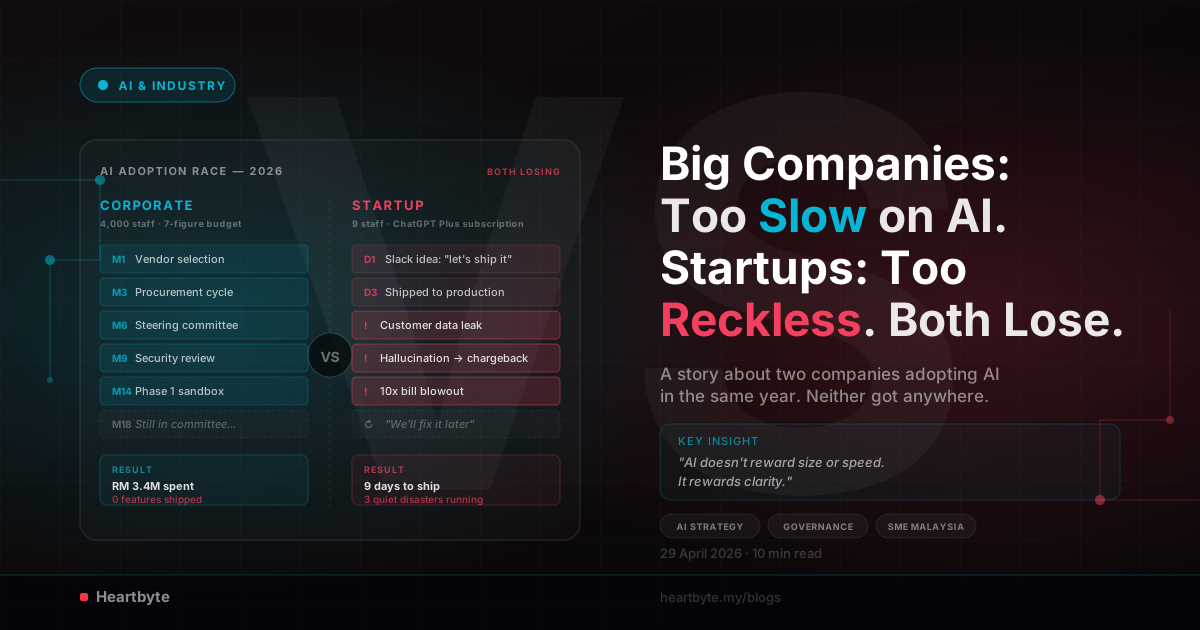
In early 2025, two companies in Kuala Lumpur decided they were going to "do AI." One was a 4,000-person group with revenue in the billions. The other was a 9-person SaaS startup running off one developer's laptop. They started in the same week, and they both wanted the same thing: an edge from generative AI before their competitors caught up.
A year later, neither of them had it.
The corporate had spent eighteen months in committee meetings, vendor pitches, security reviews, legal sign-offs, and a "Phase 1 pilot" that never reached production. The startup had shipped an AI feature in one weekend, pushed it live, and was now quietly leaking customer data into a third-party logs dashboard while a co-founder asked in a Slack channel whether anyone knew what GDPR actually said about embeddings.
"The corporate was paralysed by everything that could go wrong. The startup was unaware of any of it."
Both stories are real. We changed the names because we still talk to both of them. And both show the same thing: AI doesn't reward size, and it doesn't reward speed. It rewards something else, which most companies in this country are not yet doing.
The Corporate: 18 Months, Zero Shipped
The corporate had everything you'd want for an AI rollout. They had data: twenty years of customer transactions, sitting neatly in a Microsoft data warehouse. They had budget, a seven-figure line item set aside for "AI transformation." And they had backing from the top, with the CEO saying the word "AI" thirty-one times in the last earnings call.
What they did not have was the ability to ship anything.
Month one was picking a vendor. Three of the Big Four consulting firms pitched. Each pitch had a forty-slide deck, two case studies from European banks, and a price tag in the high six figures. Month three was procurement. Month five was the kick-off workshop. Month six was the first "AI Steering Committee" meeting, which produced a 70-page strategy document that nobody was allowed to act on without sign-off from another committee.
Then came the security review. Then the legal review. Then the data classification review, because nobody could agree whether the customer data going into the model was "internal," "confidential," or "restricted." Then a six-week argument about whether the model should run in Azure West Europe (closer to compliance teams) or Azure Southeast Asia (closer to actual customers).
Eighteen months in, the corporate had produced:
- ▸ One internal "AI Centre of Excellence" with five full-time staff.
- ▸ Three external consulting reports totalling 412 pages.
- ▸ A "Phase 1 pilot" running on five sample documents in a sandbox nobody outside IT could access.
- ▸ Zero customer-facing AI features. Zero internal-staff-facing AI tools. Zero measurable productivity gain.
- ▸ RM 3.4 million in external fees, plus internal headcount.
Meanwhile, an off-the-books WhatsApp group of mid-level managers had started using ChatGPT on their personal phones to write reports, summarise meetings, and draft client emails. They got more value out of a USD 20 personal subscription than the whole RM 3.4 million programme had delivered. Nobody told the AI Steering Committee. They were too busy getting ready for the Phase 2 review.
"The fastest AI adoption inside the corporate happened entirely outside the corporate's AI programme — on personal phones, on free accounts, with zero governance and zero attribution."
The Startup: 9 Days, Three Quiet Disasters
The startup did the opposite of everything the corporate did. No committees. No strategy document. Just a Friday afternoon, a co-founder reading a Hacker News thread, and a Slack message that said "we should put GPT into the product before our competitors do." By Monday morning there was a feature flag in production.
On paper, this is the success story. Move fast, ship things, learn from real users, the whole Silicon Valley playbook. On every surface-level measure, the startup beat the corporate by a mile. They had AI in production while the corporate was still arguing about Azure regions.
Then the problems started arriving, one by one, all of them quiet.
The data leak nobody spotted
The feature sent customer data, names, emails, support tickets, straight into the OpenAI API. Normal usage. What the team hadn't read was the part of the contract about logging. Six weeks later, a customer asked an awkward question about where their data had been processed. The honest answer involved a US-based logging endpoint that wasn't mentioned in the privacy policy. The startup quietly changed the policy, hoped nobody noticed, and added "data residency" to a backlog they would never get to.
The hallucination that went to a real customer
The AI feature confidently told a customer the platform had a refund policy that didn't exist. The customer screenshotted it, demanded the refund, and threatened a chargeback. The team scrambled to write a system prompt that "fixed" hallucinations, which it didn't, because that's not how language models work. They added a tiny "AI may make mistakes" line in light grey text under the output, and called it a control.
The bill nobody had budgeted for
Nine months in, the startup's OpenAI bill had blown up to ten times the original estimate. Not because of growth, but because every customer interaction now fired off three or four model calls, and the team had wired the most expensive model into a code path that handled 90% of traffic. The CTO found this on a Sunday night while looking for something else. By then, AI costs were eating most of the product's margin.
From the outside, the startup looked like an AI success story: running in production, user testimonials, a feature page. From the inside, the AI feature was a leaky, expensive, legally exposed bolt-on that the team was too busy to fix, because they were already shipping the next thing. Every problem above is fixable. None of them were being fixed. They were being put off.
"Shipping fast didn't mean shipping well. It meant shipping the same problems the corporate was afraid of, just faster, and without anyone noticing yet."
Same Disease, Different Symptoms
It's tempting to look at these two stories and say the corporate had too much bureaucracy and the startup had too little discipline. That's true, but it misses the deeper point. Both companies had the same problem: they didn't really understand what they were adopting. They just hid it in different ways.
The corporate hid behind process. If we don't understand it, we'll set up a committee, hire a consultant, write a strategy, run a pilot, schedule a review. Each step felt like progress. None of them required anyone to actually understand the technology. You can run a whole AI programme without ever reading what a token is.
The startup hid behind speed. If we don't understand it, we'll just ship and find out. Fail fast. The problem is that AI doesn't fail fast. It fails quietly, three months later, in a support ticket or a privacy complaint or a finance review. By the time the failure shows up, the team is six features deep into something else, and half the product now leans on that first feature.
The two failure modes, side by side:
Corporate failure
- ▸Many meetings, no decisions.
- ▸Strategy without product.
- ▸Vendor-led, not problem-led.
- ▸Risk-averse to the point of paralysis.
- ▸Everyone's covered, nobody owns it.
Startup failure
- ▸Ship first, ask questions never.
- ▸Demo without controls.
- ▸Hype-led, not problem-led.
- ▸Risk-blind to the point of negligence.
- ▸Everyone's shipping, nobody's reviewing.
Look at the third row. One was led by a vendor, the other by hype. Neither was led by a problem. Neither company started from a clear, painful business problem and asked "is AI the right tool for this?" They both started from "we should be doing AI" and worked backwards. That's the real root cause, and it's why both stories ended in the same place: money spent, time spent, no real edge gained.
Why Malaysian SMEs Get Hit Worst
Most Malaysian businesses sit between these two extremes, and they often get the worst of both. They decide as slowly as a corporate (every IT spend goes through the boss, the brother-in-law accountant, and a vendor demo) but they're as green technically as a startup (no in-house engineers, no security reviews, no idea what they're signing). They take six months to pick a tool, then six days to wire it into customer data with no controls at all.
We've sat in meetings where a 30-staff company in Klang Valley spent three months checking out "AI vendors" and then signed a contract for a basic ChatGPT wrapper that any of their staff could have built in an afternoon. We've also seen the opposite: a 12-person team in Penang who pasted their entire customer database into a free AI tool to "see what insights come out," and only realised afterwards that they'd just sent every name, IC number, and transaction record to a US server whose terms allowed it to train on the data.
"Malaysian SMEs don't fail at AI because they're too small or too cautious. They fail because they swing between the two extremes — process when they should be moving, speed when they should be thinking."
What Actually Wins
The companies getting real value out of AI right now, and there are some, here and overseas, don't fit neatly into "corporate" or "startup." They do four things together, and all four matter.
They start from a problem, not from the technology
Not "how do we use AI?" but "where is someone spending hours on a repetitive judgment task with clear inputs and clear outputs?" That's where AI fits. Document review. Lead qualification. Sorting support tickets. Keying in orders from PDFs. Find the painful, expensive, repetitive thing first, then ask whether AI fits it. If you can't name the problem before you name the tool, you're not ready.
They ship small and ship narrow
The first AI feature is internal only, low stakes, and easy to pull back. Not a customer-facing chatbot. Not a feature page. Maybe a tool that summarises sales calls for the manager's weekly review. Maybe a search over your own knowledge base. The goal is to learn how your team uses AI output, where it gets things wrong, what data the model needs, and what controls you'll need, all before any of that learning has to happen in front of a customer.
They treat governance as a feature, not a project
Where data lives, what gets logged, what happens when the model fails, a cost ceiling, someone checking the output: none of these are a separate "phase 2." They're built into the first version. Not because a compliance team forced it, but because the team building the feature understands what it does. A 5-person team can do this, and a 5,000-person team can fail to do it. The difference is whether the people shipping it have actually read what they're plugging into.
They own their data before they outsource the model
The model is a commodity. Yours, your competitors', everyone's, they're all calling the same few APIs. The one thing that gives you a real edge is your data: your past transactions, your customer records, your operational documents. Companies winning at AI know exactly what data they have, where it lives, and what they're allowed to do with it. Companies losing at AI are still working that out while paying USD 0.30 for every plain, no-edge API call.
"AI rewards companies that know their own data, their own workflows, and what they actually want from the technology. Size doesn't help. Speed doesn't help. Clarity helps."
The Test Before You Start
If you're about to spend money on AI, whether it's an internal tool, a customer feature, or a vendor contract, answer four questions before the first ringgit goes out. If you can answer all four, you'll probably get value. If you can't answer any of them, you're about to repeat the corporate's eighteen months or the startup's nine days. Both are expensive, just in different ways.
Question 1
What is the specific business problem this is solving?
"Improve productivity" is not an answer. "Cut the 4 hours a week our sales team spends summarising customer calls" is.
Question 2
What data does the model need, and where will that data go?
If the answer involves customer records going to a third-party API, you need to know what that API does with them. If you don't know, find out before, not after.
Question 3
What does failure look like, and who notices?
If the model hallucinates, if the API is down, if the cost jumps 10x, what does the user see, who gets paged, what's the backup plan? "We'll deal with it when it happens" is not a plan.
Question 4
If we removed the AI tomorrow, would anyone notice?
If the answer is no, the AI isn't doing anything useful. If the answer is "the whole workflow breaks," your whole workflow now leans on a third-party model, and you'd better have thought through what that means.
Bottom Line
The corporate is still in committee. The startup is still patching leaks. Neither has the AI edge they wanted, and neither will get it by doing more of the same. The corporate doesn't need another consultant, and the startup doesn't need to ship faster. Both need to do the same uncomfortable thing: slow down enough to think, then move fast enough to build.
AI is not something you buy. You can't sign a contract with the right firm and call it an edge. And it's not a weekend hack either. You can't wire an API into customer data, hope nothing breaks, and call that an edge. It sits in the awkward middle. Too fast for committees to keep up, too deep for weekend hackers to get away with.
The companies that get this right over the next few years won't be the biggest or the loudest. They'll be the ones who stopped long enough to ask "what problem are we actually solving?", picked one, shipped a small honest version of it, and learned something real before going wider. Everything else, the strategy decks, the demo videos, the LinkedIn posts about being "AI-first," is just noise from companies still stuck at one of the two extremes in this story.
"You don't win at AI by being the fastest or the most cautious. You win by being the clearest about what you're trying to do."
Thinking about AI but not sure where to start?
We help Malaysian businesses work out whether AI actually fits the problem they have, before they spend on tools that don't. Real engineering, no committee theatre, no weekend hacks.
Talk to Us About Your ProjectHeartbyte Team
Heartbyte is a bespoke software development company based in Malaysia. We build web, mobile, and custom software for ambitious businesses — with 15+ years of combined engineering experience and zero change request fees, guaranteed.