

Do Software Engineers Still Matter in the Age of AI?
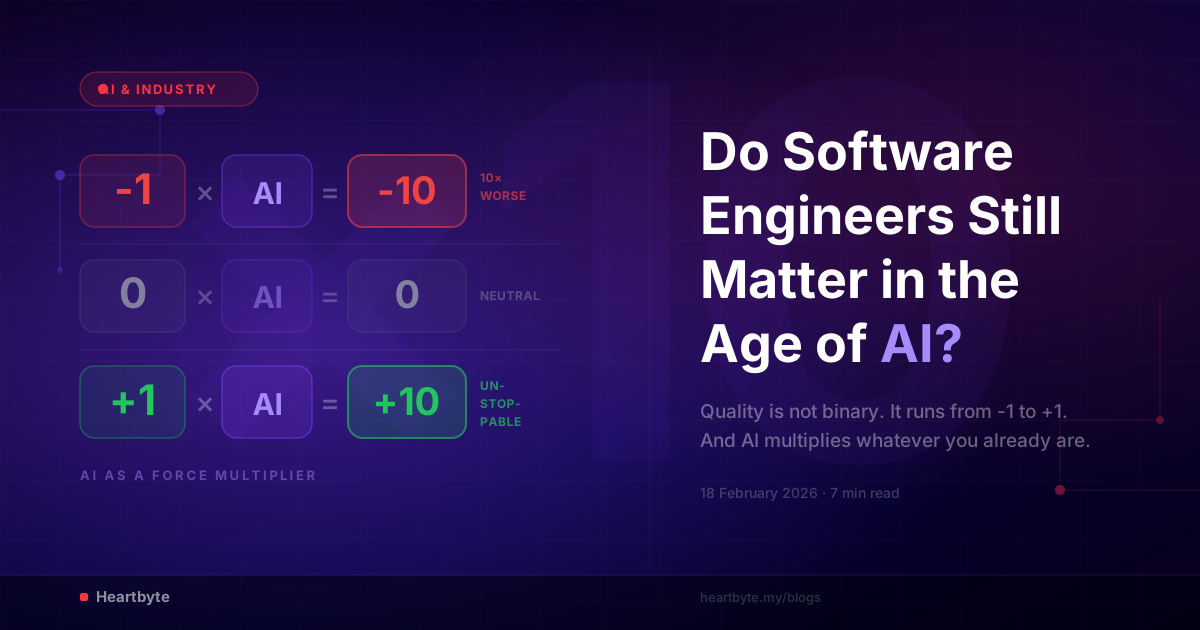
AI speeds you up, but a -1 skill times 10 is still just -10. The engineers who matter in 2026 are the ones who use AI without losing the depth that makes engineering worth paying for.
Heartbyte Team
Engineering & Technology
The noise keeps getting louder. Every month another article asks whether AI has made software engineers useless. Some companies are already betting yes. Smaller teams, faster cycles, more AI doing the work.
This isn't just talk. It matters to every engineer writing code today, and to every business paying them to write it.
Our answer is simple: it depends entirely on the quality of the engineer.
Quality Runs on a Scale, Not a Switch
ThePrimeTime put this better than anything else we've heard. Programmer quality isn't on or off. There's no clean line between "can code" and "can't code." The scale runs from -1 to 1.
The engineer who multiplies
Ships clean code that's easy to maintain. Other people can read it, build on it, and trust it. Every feature they touch makes the next one easier.
The engineer who is neutral
Their work runs, but it slowly makes things harder. They get stuff done, but the codebase doesn't get any better with them around.
The engineer who causes harm
Actively makes the codebase worse. Broken structure, security holes, tangled spaghetti nobody can maintain. Every feature they ship makes the next one harder, and other people have to clean up after them.
This matters a lot once you bring AI into the picture.
AI Is a Multiplier, and That Changes Everything
Think of AI tools as a multiplier on whatever skill you already have. If you're at +0.8, a 10× boost puts you well above what one engineer could do alone. You ship more, think wider, move faster, and catch problems earlier.
But if you're at -1? That same 10× tool won't fix your skill. It just multiplies the damage. You ship 10× the broken code, 10× the security holes, 10× the mess nobody can maintain. And at that speed, the problems get buried deeper before anyone notices.
"AI doesn't save mediocre engineers. It accelerates them — for better or for worse."
This is the risk nobody is saying out loud. The companies racing to replace engineers with AI and a prompt are about to find out what happens when a -1 times 10 hits production.
The Acceleration Is Real, and It's Not Going Away
The speed-up is happening, and it's real.
Engineers now show up to work with features already half-built. They've been chatting with AI on the commute, working through bugs, looking at API options, sorting out the logic. By 9am they have a working draft that would've taken three hours yesterday.
Work that used to take weeks now takes days. Companies that adapt will out-build the ones that don't. We're not sceptics here. The gains are real and they stack up over time.
But Speed Without Comprehension Compounds Risk
This is where it gets tricky.
When engineers ship code they don't really understand, the tech debt doesn't just pile up. It snowballs. Each feature built on a shaky base is harder to change than the last. Each shortcut makes the next shortcut easier to take. The codebase turns into a black box that even the people who built it can't follow anymore.
The dangerous engineers right now aren't the ones using AI. They're the ones using AI instead of thinking. Copying AI output you don't understand is just blindly copying patterns at 10× speed. It looks like engineering and it ships features, but it breaks the system in ways you won't see until something blows up in production, usually at the worst possible time.
What Happens When Engineers Stop Writing Code
There's a quieter problem on top of all this. When engineers stop writing code, actually writing it instead of just checking AI output, they lose something important over time.
The ability to debug at depth
When a system fails at 3am and the AI gives you five possible causes that all sound right, you need an engineer who can trace a call stack, read a flamegraph, and know why this exact call is the one that deadlocked. That gut feel comes from years of writing code, breaking things, and fixing them. You don't get it from checking AI output.
The ability to refactor with confidence
Cleaning up a messy codebase, cutting 2,000 lines down to 400 without breaking anything, means you've got the whole system in your head. The engineer who suggests a good refactor has a mental map that no AI can fully replace.
The ability to propose before implementing
Before a single line of code gets written, the best engineers are already thinking it through: Do we scale out or scale up here? Should this be a microservice or stay one big app? Is PostgreSQL the right fit, or do we need Cassandra for this write pattern? Which cloud provider fits our compliance needs and our budget?
These are judgment calls. You need to understand the business goals, the tech, and the trade-offs. AI can lay out the options, but an experienced engineer still has to make the call and live with it.
The Engineers Who Will Thrive
The engineer worth paying for in 2026 looks like this.
They use AI well and without fear. It's part of their daily work, a tool to lean on rather than hide behind. They're not precious about it, and they ship faster because of it.
But they keep their depth. They still read stacktraces. They still write code when AI could do it faster, because the act of writing keeps the mental map sharp, and that map is what makes everything else work.
They understand whole systems, not just features. They know how data flows, where things slow down, and how it all falls apart under real load. They think about what could break before they think about syntax.
They think before they code. Before they touch a keyboard, they can sketch the design, spot the risks, and pick the right tools for the job. Not the trendy ones. The right ones.
The Bottom Line
AI has raised the floor, so churning out mediocre work at scale is easier than ever. It has also raised the ceiling, so the best engineers can do more than they ever could.
The ones who'll struggle are the engineers using AI to skip the thinking that made engineering worth paying for in the first place.
Quality isn't 0 or 1. It runs from -1 to 1.
Whatever your number is, AI multiplies it.
If your skill is -1, no tool in the world will save you.
If your skill is +1, AI makes you unstoppable.
So the question for every engineer reading this isn't whether AI matters. The question is: what number are you?
Heartbyte Team
Heartbyte is a bespoke software development company based in Malaysia. We build web, mobile, and custom software for ambitious businesses — with 15+ years of combined engineering experience and zero change request fees.