

You're Not Paying Us to Fix Things. You're Paying Us So You Never Have To.
A real client asked why their maintenance bill keeps coming when nothing ever breaks. Here's the honest answer, and why "nothing happens" is what good maintenance looks like.
Heartbyte Team
Engineering & Strategy
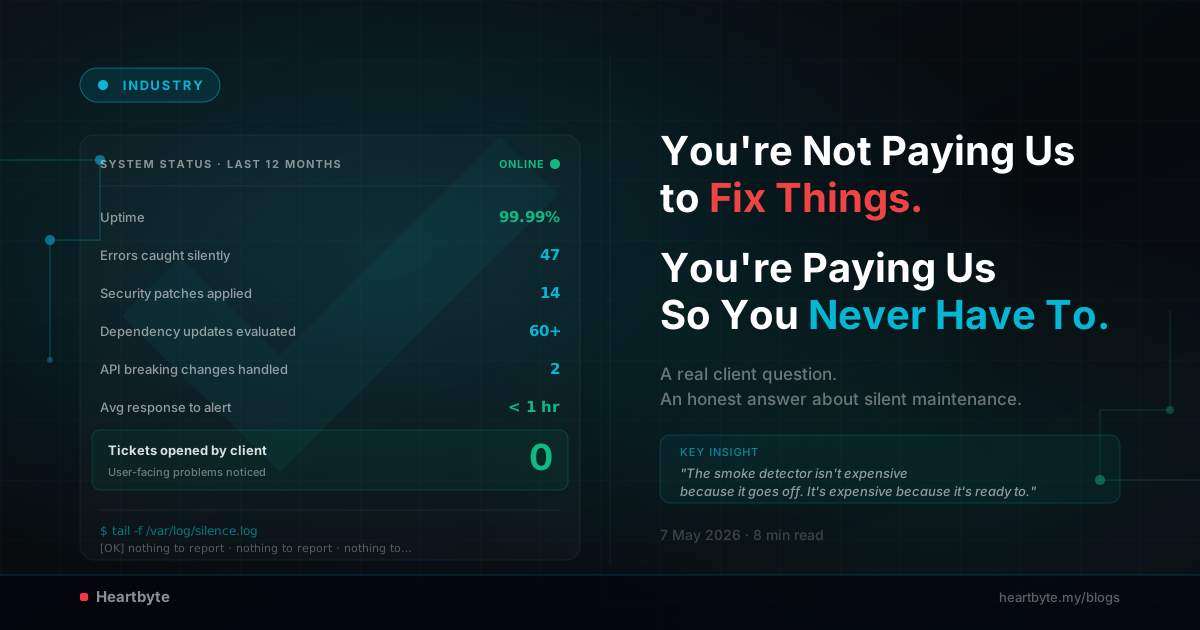
A client called us last week with a fair question. They've been paying our yearly maintenance fee for over a year now. In that time, they haven't logged a single bug. They haven't asked for a single change. The system just runs. Their team is happy. So they asked us something pretty reasonable:
"Why am I still paying you if nothing ever breaks?"
It's a fair question. It deserves a real answer, not a defensive one. So here it is, written down properly. If one client is asking it, twenty more are thinking it.
The Paradox of Invisible Work
Software maintenance is the only job in the world where doing it perfectly makes the customer wonder why they hired you.
A lawyer wins a case and you get a verdict. A doctor does surgery and you get a scar and a recovery. A mechanic fixes your car and you hear it run again. Every other service gives you something you can see and point at, a receipt for a moment that happened.
Good software maintenance gives you nothing to see. No "fixes" on the invoice. No emergency calls. No 2am phone calls. No dramatic rescues. Just a system that keeps doing its job, week after week, while the people who built it stay in the background.
"The better we do our job, the less you notice we're there. That's not a flaw in the deal. That is the deal."
What Actually Happened in the Year You "Didn't Need Us"
So here's some of what actually happened on this client's system over the year they thought nothing was happening.
Behind the silence — one year, one client
Minor errors caught and resolved before anyone noticed.
Our monitoring caught each one, sent it straight to an engineer, and we fixed it, usually within an hour. None of them ever reached a user. So none of them ever became a ticket.
Security patches applied to the framework, database, and server.
Three of them fixed holes that attackers were already using out in the wild, within days of the holes being made public. We patched them, and the client never had to know, because they were never at risk.
Library and dependency updates evaluated.
We picked which ones to take, which to wait on, and which to skip, then tested each one against the live code. The point of having someone on this isn't to grab every update. It's to know which ones to leave alone.
Third-party API breaking changes caught before users did.
A payment gateway changed how it sent back webhook data. A mobile OS changed how it handled file uploads. Both would have caused visible bugs. We patched both before any real traffic was hit.
Backups verified, certificates renewed, logs rotated, servers rebooted on schedule.
The boring upkeep that stops a system from rotting. It matters, and you only notice it when nobody's doing it.
None of this is on the invoice, because it's not the kind of work that creates an invoice. It's the kind of work that stops one from ever showing up.
The Smoke Detector Test
There's a smoke detector in your office. You paid for it. You change its battery. It has been "doing nothing" for years.
Would you remove it because nothing has ever caught fire?
You don't pay for the smoke detector because it goes off. You pay for it because it's ready to go off. Pulling it out doesn't save you money. It just swaps a small, steady, known cost for a small chance of a huge one. The bet looks great right up until the day it doesn't.
Software maintenance is the same thing, just sold differently. The fee buys readiness, not hours of work. It's why insurance, gym memberships, fire extinguishers, and on-call doctors all work the same way. None of them are "doing anything" most of the time, and that's the whole point.
What Cancelling Maintenance Actually Buys You
Want to run the test? Cancel maintenance on a working system and watch what happens over the next 24 months. We've seen it play out plenty of times, usually with companies who hire us after the test is over.
The 24-month cancellation timeline:
Genuinely nothing.
The system keeps running. The decision looks like a smart cost cut. Someone on the leadership team feels good about it. Everyone moves on.
Quiet decay begins.
A library goes out of date. A browser changes how it handles a tag. The payment gateway updates its API. Each one is small on its own. Nobody fixes any of them because nobody's watching. The small problems start to stack up underneath.
The first real incident.
Something breaks badly enough that a user notices. Now you're scrambling to find an engineer. But the team that built the system has moved on, anyone new finds the code confusing, and the only "documentation" was in someone's head a year ago. So you're paying emergency rates to someone working a weekend to get it back up.
Panic rebuild or rescue quote.
Either a panicked full rewrite, or a quote from a vendor willing to take the system on as a "rescue project," priced to match. The original team is long gone and out of reach. Whatever they knew is now buried in a Slack history nobody can search.
"The total cost of cancelling maintenance, for the typical small business system, is usually 4–8× what the maintenance fee would have been. Plus downtime. Plus customer trust. Plus the meeting where someone has to explain to leadership why this happened."
What the Fee Actually Buys
Stop thinking of the fee as "payment for work done this month." That only makes sense for one-off projects. Maintenance is more like insurance or a gym membership. You're not paying per fix. You're paying for someone whose job is to be ready, watching, and up to date.
Eyes on the system, every minute.
Monitoring that alerts a real engineer the moment something looks wrong, not a ticket queue someone gets to on Monday. That 1-hour response your team has been enjoying comes from this.
A response that knows your codebase.
When something does break, the engineer who responds already knows your system. They're not a stranger reading it for the first time at midnight. That saves you hours, not minutes, and sometimes it's the difference between a non-event and a real outage.
Built-up knowledge that never shows up on an invoice.
A year from now, we still know why a piece of code was written that way, who asked for it, what depends on it, and what would break if you changed it. That knowledge is worth more than the code itself, and it disappears the moment the relationship ends.
Work that stops the work you'd actually have to pay for.
Security patches, library upgrades, compatibility checks: the boring upkeep that keeps "nothing happening" from turning into "everything is broken." This is most of the real hours, and it's the part you should be glad you're not seeing.
A head start the day you do need a real change.
The day a new feature, a new rule to follow, or a new integration becomes urgent, you're not starting from "find a vendor and brief them for two months." You're starting from "we already know." That's worth something too, even on the days you don't use it.
The Honest Answer
So when our client asked why they're still paying us if nothing breaks, the honest answer is the one we gave them, and the one we'll give anyone who asks.
Nothing breaking is the product. The 47 quiet problems you didn't see, the 14 patches you never got an alert about, the API change that didn't cost you a customer: none of that proves you don't need us. It's the receipt for what you've been paying for.
You're not paying us to fix things. You're paying us so you never have to. The day the bill stops feeling worth it is usually the same day the bill is doing the most for you.
"If we ever do our job badly enough that you notice us every month, you should fire us. If we do our job well enough that you stop noticing — that's exactly the deliverable. That's what the fee is for."
Tired of maintenance fees that feel like a black box?
We send our maintenance clients an honest report every quarter: every error caught, every patch applied, every API change handled. You get to see the quiet work, item by item. That's how a fair maintenance deal should work.
Talk to Us About Your ProjectHeartbyte Team
Heartbyte is a bespoke software development company based in Malaysia. We build web, mobile, and custom software for ambitious businesses, with 15+ years of combined engineering experience and zero change request fees, guaranteed.