

Technical Debt: The Silent Tax That's Slowly Killing Your Business
Every shortcut you took three years ago is still charging you interest. Technical debt doesn't come in an envelope. It shows up as slower deliveries, scarier releases, and a team that's worn out from keeping the lights on.
Heartbyte Team
Engineering & Strategy
Ask any business owner if they have technical debt, and you'll usually get a blank stare, or a confident "no, we don't have that problem." Ask their engineers the same thing, and you'll get a long pause and a nervous laugh.
That gap between what the business sees and what the system really is, that's where technical debt lives. It's not a line on any invoice, and it's not on the balance sheet. But it shows up in every release that takes three times longer than it should, every bug fix that breaks two other things, every engineer who quietly updates their CV because the code has become unbearable to work in.
"Technical debt is the only loan your business has taken out without signing for it — and it's been compounding daily ever since."
This article isn't really about code. It's about what those shortcuts cost you in money, in daily operations, and in the moves you can no longer make. Most businesses only notice the bill once it's too big to ignore.
What Technical Debt Actually Is (In Plain English)
Say you're renovating your office. You need the meeting room ready by Monday. The proper way takes two weeks. The "just make it work" way takes two days: run an extension cord across the floor, tape it down, and tell yourself you'll wire it properly next month.
Monday comes. The meeting room works. Nobody trips. Everyone moves on. Two years later there are seventeen extension cords across that floor, each taped down by a different person, and nobody remembers which one powers what. Pull the wrong cord and the boardroom projector dies. That's technical debt.
Technical debt, in three sentences:
The shortcut
You went with the fast fix instead of the right one because the deadline, the budget, or the customer pushed you to.
The interest
Every future change has to work around that shortcut. Every engineer who touches that area slows down. The cost piles up quietly.
The default
One day the system is so tangled that simple requests take weeks, and starting over feels cheaper than fixing it. That's when the debt comes to collect.
The shortcut itself isn't the problem. Sometimes a shortcut is the right call. The problem is that nobody tracks the interest, nobody writes it down, and nobody pays it back. By the time you can see the debt, it's already eaten a big chunk of what your team can get done.
How It Accumulates, Silently, Day by Day
Nobody sets out to build a tangled system. Technical debt builds up through a thousand reasonable-looking decisions, each one fine on its own. The problem is all of them put together.
A vendor ships a feature that "kind of works" because the deadline is Friday. A new developer copy-pastes a module instead of cleaning it up because they don't want to break anything. A manager asks for "just a small change" that ripples through ten files nobody wants to touch. A library stops getting updates, but ripping it out would take two weeks of testing nobody has. Each of these calls makes sense on its own. Stack them up over three years and you have a disaster.
The most common sources of technical debt:
Deadline-driven shortcuts
"We'll clean it up after launch." Launch happens. The next project starts. Nobody goes back. The shortcut becomes the base the next feature gets built on.
Vendor handovers
The original agency built fast, billed you, and left. The code has no comments, no docs, no tests. Every change starts with hours of digging just to figure out what's there.
Requirements that changed mid-build
The system was built for workflow A. Halfway through, it became workflow B. The design never caught up, so now the code tries to support both, badly.
Frameworks and tools that aged out
The library you picked in 2019 is now dead. The PHP version is past its support date. The payment gateway killed off its v1 API. The world moves on. Your system doesn't.
Knowledge that walked out the door
The one person who understood the billing module left two years ago. Nobody took their place. Now everyone touches it with the same silent prayer: "please don't break."
None of these are engineering failures. They're just how business works. The question was never whether technical debt shows up, because it will. The question is whether anyone is keeping track of it.
Why It Compounds Like a Loan You Can't Refinance
One thing makes technical debt worse than normal debt: you can't call the bank and ask for a lower rate. The interest keeps building whether you look at it or not.
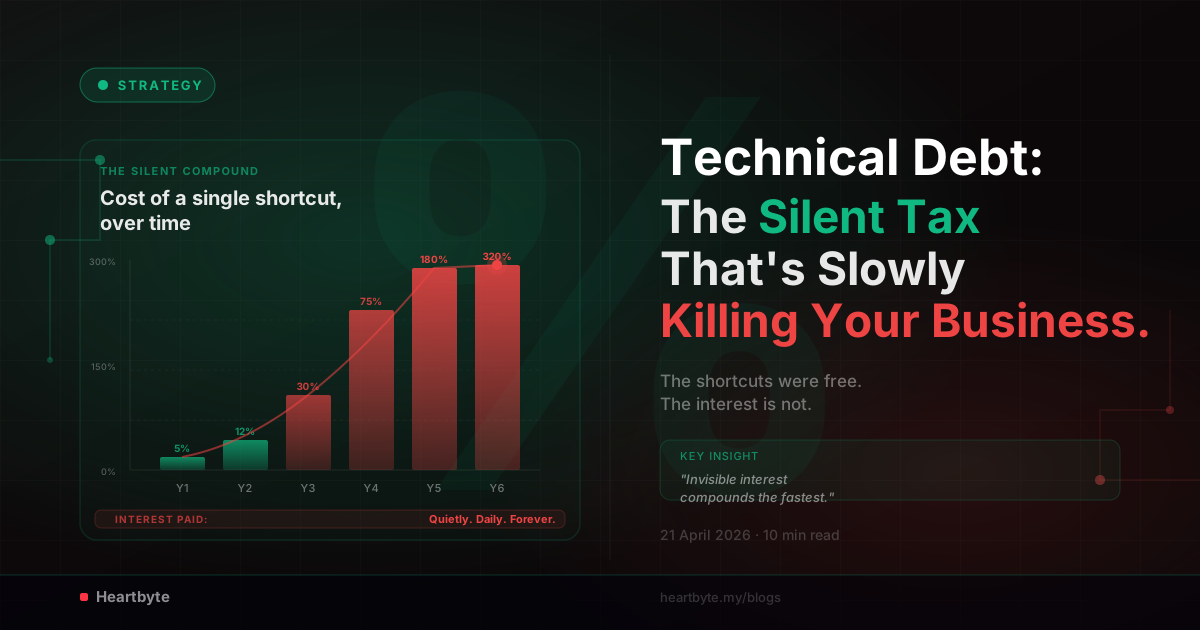
In year one, the shortcut costs you maybe 5% extra effort on nearby work. By year three, it's 30%. By year five, every feature that touches that area takes two to three times longer than it should, and half the time it breaks something unrelated. Your engineers aren't lazy. They're picking their way through a minefield that every past decision left behind, and nobody wrote down where the mines are.
"The first shortcut costs 5%. The tenth shortcut in the same module costs 300%. Technical debt doesn't add — it multiplies."
And because you can't see the debt, the business keeps making decisions as if it isn't there. The CEO asks why a "simple" feature takes three months. The CTO tries to explain without saying "our code is on fire." The engineers quietly add a week to every estimate because they know what they're walking into. Everyone is frustrated. Nobody can name the real cause.
The Real Business Costs (It's Never Just Technical)
Technical debt is a business problem wearing an engineering costume. The costs land on your P&L, on how happy your customers are, and in the end on whether your company can move at all.
Where technical debt actually hits your business:
Delivery slows to a crawl
Features that should take weeks take months. Your competitors ship three releases in the time you ship one.
Bugs multiply faster than fixes
Fixing one bug creates two new ones because everything is tangled together. Your bug list grows every month.
Team burnout and turnover
Good engineers don't leave because of money. They leave because they're tired of being afraid of their own codebase.
Hiring gets harder
Nobody wants to inherit a legacy mess. The better the engineer, the faster they spot it in their first week, and the faster they leave.
Customer trust erodes
Outages become normal. Support tickets pile up. Clients stop believing your timelines because your timelines stopped being honest.
Strategic options disappear
You can't pivot. You can't enter a new market. You can't hook up a new partner. The system just won't bend.
That last one is the most dangerous. Technical debt quietly takes options off the table. A company buried in debt can't say yes to good opportunities, not because they don't want to, but because the system can't handle them in any reasonable time. You never notice the deals you couldn't chase. You just notice, years later, that you stopped being ambitious.
The Warning Signs You're Drowning (And Don't Know It)
Most businesses don't go looking for their technical debt. It finds them, usually during a big release or a failed integration. The signs were there all along, if anyone had been watching.
Estimates keep getting longer for the same kind of work
A feature that took two weeks last year now takes six. Nothing new is being built. It's just getting harder to do anything at all. That's not a team problem. That's an interest payment.
Fixes cause other fixes
Every bug fix breaks something else. Your engineers have started saying "we shouldn't touch that" about whole modules. The system is now full of quiet landmines.
Nobody wants to work on the system
Your best engineers drift toward the brand-new projects. The old system gets handed to the most junior person, not because it's easy, but because the senior engineers have quietly said no. That's a warning sign in neon lights.
Critical knowledge lives in one person's head
If your finance module can only be changed by one person, and that person is on leave when something breaks, you don't have a system. You have a hostage situation. When the knowledge lives in one head, that's debt at its most dangerous.
Deploys feel like surgery
Every release is scheduled for Saturday night, every deploy needs a list of manual steps, and the rollback plan has a footnote that says "pray." How painful it is to ship is the most honest measure of your technical debt.
Why Your Team Hasn't Told You Yet
There's a reason the business owner and the engineering team rarely see the same picture. The engineers know. They've known for a long time. But telling leadership "our code is drowning us" is a risky thing to say if the person you're telling doesn't get what it means.
So instead, engineers soften it. They pad their estimates, they steer clear of the risky areas, and they tell you "it's a bit complicated" when they mean "this module is held together by duct tape and hope." They don't lie. They just play it down, because every time they've tried to explain the real state of things, the answer has been some version of "just make it work."
What engineers say vs. what they mean:
What they say
"This might take a bit longer than expected."
What they mean
"I'm about to open a module nobody has touched in 18 months and I have no idea what I'll find."
What they say
"We should really refactor this at some point."
What they mean
"If we don't rewrite this part within 12 months, we won't be able to ship anything new on top of it."
This gap isn't anyone being a villain. It's just how the incentives are set up. Leaders get rewarded for shipping visible results, not for spending money on foundations nobody can see, so the foundations rot. By the time they cave in, everyone blames the engineers, when the real cause was ten years of "just make it work."
How to Actually Pay It Down
The good news is you don't need to "refactor everything" or "rewrite the whole system." Rewrites almost always fail. They're the nuclear option, and that rarely pays off. What actually works is boring, steady, and done a bit at a time.
Make the debt visible
Before you can pay it down, you have to see it. Ask your team to keep a real list. Not a spreadsheet of vague worries, but concrete items: "this module has no tests," "this library dies in March," "this deploy is all manual." You can't manage what nobody has written down.
Allocate a fixed percentage of capacity
Every sprint, every quarter, every roadmap, set aside 15–20% of your engineering time to pay down debt. Not "when we have time," because that time never comes. Make it a fixed budget and treat it like payroll.
Fix what hurts, not what looks ugly
Don't clean up something just because it's ugly. Fix what's actually slowing the business down. Which module eats the most time to estimate? Which area throws the most bugs? Which system needs someone to step in by hand every week? Those are the ones bleeding money. Fix those first.
Stop adding new debt without tracking it
When you take a shortcut, and sometimes you have to, write it down as a debt item right away. The real cost of a shortcut isn't the shortcut. It's the one you forgot you took. Debt you track is manageable. Debt you don't know about can kill you.
Translate debt into business outcomes
"Refactoring the billing module" won't get funded. "Cutting our monthly billing support tickets from 40 to 5, and dropping invoice generation from 3 days to 1" will. Never sell debt work as engineering tidiness. Sell it as the business problem it actually fixes.
"You don't need to pay off all your debt. You just need to stop paying interest you didn't know you were paying."
The Debt Is Already There. The Only Question Is Whether You're Paying Attention.
Every system that's actually in use has technical debt. Yours does. So does ours. The question was never whether it's there. It's whether anyone is tracking it, budgeting for it, and paying it down.
Businesses that ignore it pay anyway. They pay in late launches, lost customers, burned-out engineers, and good opportunities that quietly slip away without anyone noticing. Businesses that deal with it head-on spend maybe 15% of their time on upkeep, and they move three times faster on everything else, because the ground they build on is solid.
The most expensive kind of debt is the kind you refuse to look at, because the interest you can't see grows the fastest. If you've read this far and you're seeing the signs in your own business, that's the first real payment. Everything else starts the moment you decide to look at it clearly.
"The shortcuts are already taken. The interest is already accruing. The only real question is: are you still pretending the bill won't come?"
Not sure how much debt is hiding in your system?
We help businesses audit old systems, work out what technical debt is really costing them day to day, and build a step-by-step path back to code that doesn't scare anyone. No rewrites, no drama, just honest engineering and a plan you can actually afford.
Get a Technical Debt AuditHeartbyte Team
Heartbyte is a bespoke software development company based in Malaysia. We build web, mobile, and custom software for ambitious businesses, with 15+ years of combined engineering experience and zero change request fees, guaranteed.