

The Hidden Cost of Change Request Fees (And How to Avoid Them)
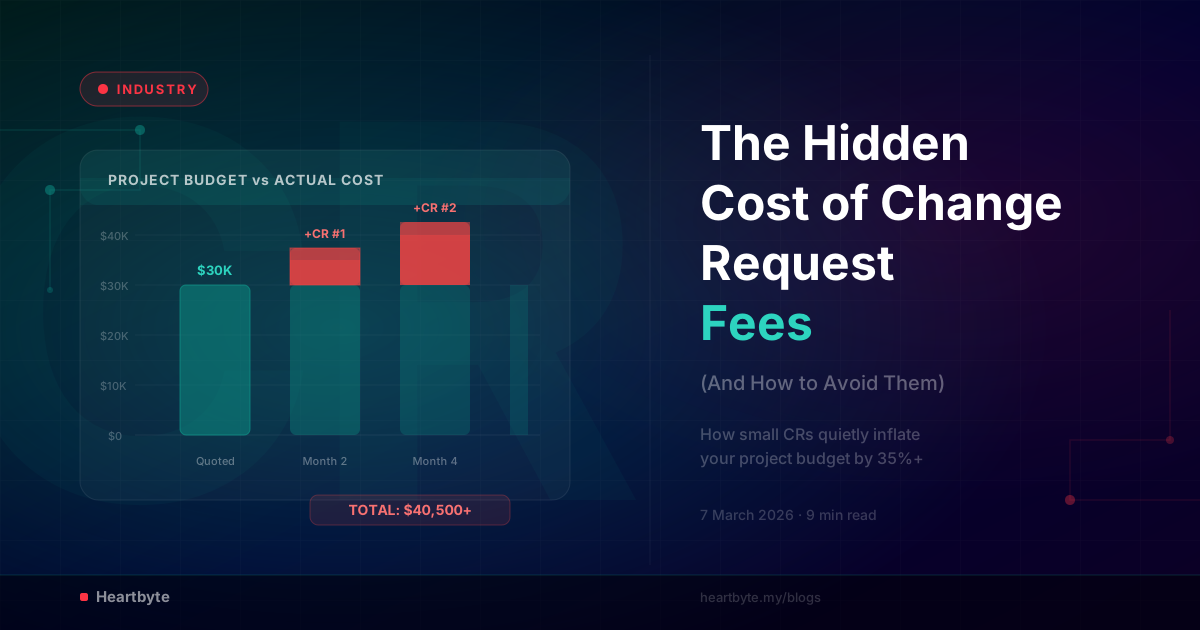
Your project was quoted at $30,000. Six months later, you've paid $40,500. Nobody lied, nobody cheated, but somehow the budget blew up one change request at a time.
Heartbyte Team
Engineering & Technology
If you've ever worked with an IT vendor or software agency, you've probably run into a change request. Maybe it was put nicely: "we'll just need a small CR for that." Maybe it came with a formal document and a new timeline. Either way, it came with a price tag.
On its own, each change request feels fair. A few thousand here, a small tweak there. But over a whole project, these fees add up to something much bigger, and most businesses don't see the real cost until the final invoice lands.
What Is a Change Request?
A change request, or CR, is the formal process agencies and vendors use when a client asks for something that wasn't in the original scope. It could be a new feature, a design change, a workflow tweak, or even a tiny adjustment the vendor calls "out of spec."
The agency writes up the change, estimates the work, puts a price on it, and sends it to you to approve. Once you say yes, they build it, the timeline shifts, and the bill goes up.
The typical CR lifecycle:
Client requests a change. "Can we add one more field to this form?" or "Can we adjust the approval workflow?"
Agency works out the effort. Even small changes get scoped, written up, and priced as a formal change request.
Client approves (reluctantly), because saying no means living with a system that doesn't quite work.
Budget creeps upward, and the cycle repeats for the next change, and the next one after that.
On paper, that sounds fair. Extra work deserves extra pay, and that's true. But in real life, the CR model means the client pays extra because the agency didn't fully understand the project upfront.
Why Change Request Fees Exist
To be fair, CR fees aren't inherently evil. They exist for legitimate reasons.
Agencies use them to protect their margins. Building software is hard, and without limits, scope can grow forever. A project quoted for three months can easily turn into six if every new idea gets soaked up without question. CRs are a checkpoint, a way to say "this is extra work, and it costs money."
They also keep expectations in check. When clients know changes outside the scope cost money, they think harder about what they actually need. In theory, that means clearer requirements and fewer last-minute changes.
The real problem is that CR fees have quietly become the main way agencies make money. It's steady income built on the gap between the first scope and what you actually need.
For clients, the downside is real. You get punished for learning. As you watch the system take shape and figure out what really works for your team, you naturally want changes. But every change sets off another CR. The better you understand your own needs, the more you pay.
The Hidden Cost of CR Fees
The danger with change request fees isn't any single invoice. It's how they pile up. Each CR feels small enough to approve. But over a six- or twelve-month project, those "small" charges add up to an overrun nobody planned for.
How a $30,000 project becomes $40,500:
That's a 35% overrun. And none of those changes were unreasonable. A PDF export, a workflow tweak, a UI update: these are the kinds of things that come up naturally as a project takes shape. The client didn't suddenly change their mind. They figured out what they actually needed once they could see the system working.
Scope creep gets blamed for budget overruns all the time. But the deeper issue is that a lot of projects blow past budget not because clients can't make up their minds, but because the original scope was never thorough enough to start with. The CRs are a symptom of rushed discovery work, not the real problem.
"Can we add one more feature?" "Can we adjust the workflow?" "Can we change the UI?" Each of these questions is perfectly reasonable. And each one generates another invoice.
Why This Keeps Happening
The CR cost blowup isn't random. It follows a pattern that's baked into how traditional agencies work.
Incomplete discovery phase
A lot of agencies rush through discovery to win the deal. They grab the high-level requirements, put together a slick proposal, and quote a number that looks good. But the details only show up once the work starts: the edge cases, the workflows, the real complexity. And when they do, every gap turns into a CR.
Changing business needs
Your business doesn't freeze while the software gets built. Markets shift, rules change, teams get reshuffled. A requirement that made sense three months ago might be pointless today. But the original scope document doesn't care. It was signed, and anything outside it costs extra.
Communication gaps
When the agency and client don't talk often enough, small misunderstandings pile up. The agency builds what they thought you meant, you expected something different, and closing that gap takes changes. Changes mean CRs.
Strict scope protection
Some agencies treat the scope document as a weapon. Anything not spelled out is out of scope, even if it's an obvious part of what you agreed on. That sets up a fight where the client feels squeezed for things they assumed were included.
How to Avoid the CR Cost Explosion
The good news is that CR overruns aren't a given. They come from one particular way of working, and there are better ways. Here's how to protect yourself.
Invest in thorough discovery
Before anyone writes a line of code, make sure discovery is done properly. Map the workflows. Talk to the people who'll use it. Write down the edge cases. The more careful the upfront work, the fewer surprises later.
Choose partners with flexible engagement models
Not every agency works on rigid fixed-scope contracts. Look for partners who work in iterations, where reasonable changes are expected, not punished. The best partnerships feel like working together, not a transaction.
Use agile iteration instead of rigid scope
Agile means building in short cycles, reviewing often, and adjusting as you go. Changes are normal, not exceptions. This cuts down on formal CRs because the process is built to take in feedback.
Work with teams that prioritise outcomes over billing
The best development partners judge success by whether the system works for your business, not by how many CRs they can rack up. Look for teams whose interests line up with yours.
A Better Approach: Zero CR Fees
More and more software teams are moving to friendlier ways of working. The core idea is simple: reasonable changes should be part of the process, not a way to make money.
At Heartbyte, we've worked this way from day one. We don't charge for change requests. Not because we soak up endless scope creep, but because a well-run project should expect changes anyway. When you see your system taking shape and realise a workflow needs tweaking or a feature needs polish, that's the process doing its job.
Traditional model
- ✗ Every change generates a formal CR
- ✗ Budget unpredictable until project ends
- ✗ Clients afraid to give honest feedback
- ✗ Adversarial scope negotiations
Collaborative model
- ✓ Reasonable changes included in the process
- ✓ Fewer budget surprises
- ✓ Clients iterate freely and give real feedback
- ✓ Stronger, trust-based partnership
This works because it changes what the team is rewarded for. Instead of profiting from gaps in the scope, they're motivated to get things right the first time and to handle feedback well when changes come up. You get a better product, a budget you can predict, and a relationship built on trust instead of paperwork.
The Real Cost Isn't on the Invoice
Change request fees don't just cost money. They cost momentum. Every time a change has to be scoped, approved, and invoiced, the project slows down. Decisions that should take minutes drag out over days of back-and-forth. Teams get cautious, afraid to suggest improvements because every idea comes with a price tag.
The worst part isn't the budget overrun. It's the software that ships without the changes it needed, because the client ran out of CR budget and just settled for a system that doesn't quite work.
If you're picking a software partner, look past the first quote. Ask how they handle changes. Ask what happens when you see the system and realise something needs adjusting. The answer will tell you more about the real cost of the project than any proposal ever will.
Your project budget shouldn't be a moving target.
We build software with zero change request fees, because making changes is how great products get built, not how budgets get blown.
Talk to Us About Your ProjectHeartbyte Team
Heartbyte is a bespoke software development company based in Malaysia. We build web, mobile, and custom software for ambitious businesses, with 15+ years of combined engineering experience and zero change request fees, guaranteed.