
The Real Cost of Off-the-Shelf Software (And When Custom Makes More Sense)
The subscription looked affordable and the demo was impressive. But two years in, you're paying for three tools, building workarounds in spreadsheets, and wondering where the ROI went.
Heartbyte Team
Engineering & Technology
When a company needs software, a CRM, an ERP, an accounting platform, or an inventory system, the instinct is usually the same: find a popular product, sign up, and get moving. It makes sense. Off-the-shelf software is quick to set up, trusted by thousands, and doesn't need a dev team. The price looks fair and the feature list looks long.
But there's a big gap between what software costs to buy and what it costs to own. For a lot of businesses, that gap turns a "cheap" tool into one of the most expensive decisions they'll make.
Why Off-the-Shelf Software Is the Default Choice
There are good reasons businesses reach for off-the-shelf tools first. Setup is fast, often days instead of months. The upfront cost is lower than paying for a custom build. The brand is known and well-tested, and the feature list is packed with things that took the vendor years to build.
For standard stuff like email, basic HR, payroll, and simple accounting, off-the-shelf products are often the right call. They solve common problems well.
The problem isn't off-the-shelf software itself. It's treating the sticker price as the total cost, and assuming a product built for everyone will fit you perfectly.
What most businesses never work out is the Total Cost of Ownership: the full picture over three to five years, including every hidden cost that never shows up in the sales deck.
Total Cost of Ownership: What CFOs Should Actually Measure
Total Cost of Ownership (TCO) is a simple idea that most software buyers ignore. It means looking at not just what you pay to start using the software, but what you pay to keep using it over its whole life.
The components of software TCO:
Licensing and subscription fees. Per-user, per-month costs that grow with your headcount and often jump when you move up a pricing tier.
Add-on modules and premium features. The features you actually need are often locked behind a higher-tier plan or sold as a paid add-on.
Integration costs. Connecting the software to your other systems (accounting, CRM, ERP, website) takes middleware, consultants, or custom API work.
Training and onboarding. Every new hire needs training on the platform, and complex systems require ongoing support.
Customisation limits and workarounds. When the software can't bend to your process, your team bends to the software instead, usually with spreadsheets, manual steps, and entering the same data twice.
Vendor lock-in. Once your data, workflows, and team habits are tied to one platform, switching gets expensive.
A CFO sizing up software should look at the three-to-five-year cost, not the monthly price on the landing page. Year one is almost always the cheapest year, and the real cost piles up over time.
The Hidden Costs That Don't Show Up in the Quote
Every off-the-shelf product comes with costs that only show up after you've committed. These aren't bugs or failures. They're what you get when you use software built for everyone and tuned for no one.
Licensing growth
Your company grows. You hire more staff, and every new person needs a licence. You want better reporting, so that's a higher tier. You need API access, so that's enterprise pricing. What started at $50/user/month is now $120/user/month, and you have twice as many users. The cost didn't just grow with your company. It grew faster.
Workflow workarounds
Off-the-shelf software forces its own workflow on you. When that doesn't match yours, your team builds workarounds: manual steps, double data entry, exports to spreadsheets, copy-pasting between systems. Each one looks tiny on its own. Multiply them across 40 staff over 250 working days and you've lost thousands of hours a year.
Integration costs
No business runs on one system. Your accounting software needs to talk to your CRM, your ERP needs to sync with inventory, your website needs to pull from your internal database. Each connection costs money to build, costs money to maintain, and is one more thing that can break. When one vendor pushes an update that breaks the link, you're the one paying to fix it.
Productivity loss
When software doesn't fit your process, your people bend to the tool instead of the tool bending to them. They build reports by hand. They export data, reformat it, and upload it somewhere else. They keep shadow spreadsheets because the system's reports don't give them what they need. This is the most expensive hidden cost, and the hardest to measure, because it's baked into every working day.
"We bought the software to save time. Two years later, we're spending more time on workarounds than we ever spent on the manual process it was supposed to replace."
The Economics of Custom Software
Custom software works the other way around. Instead of forcing your business into a ready-made workflow, it's built around the way your company actually runs. Your processes, your wording, your approval chains, and your reporting needs are all in there from day one.
What custom software changes economically:
No per-user licensing
You own the system. Adding 10 or 100 users doesn't change your cost. Growing doesn't bump you into a higher pricing tier.
Built-in automation
Jobs that needed manual workarounds with off-the-shelf tools can be automated right into the system, cutting out hours of repetitive work.
Native integrations
Instead of stitching systems together with middleware, custom software plugs straight into your existing tools. Fewer things break, and less to maintain.
Long-term ownership
No vendor can kill your features, force a migration, or triple your bill. The system is yours.
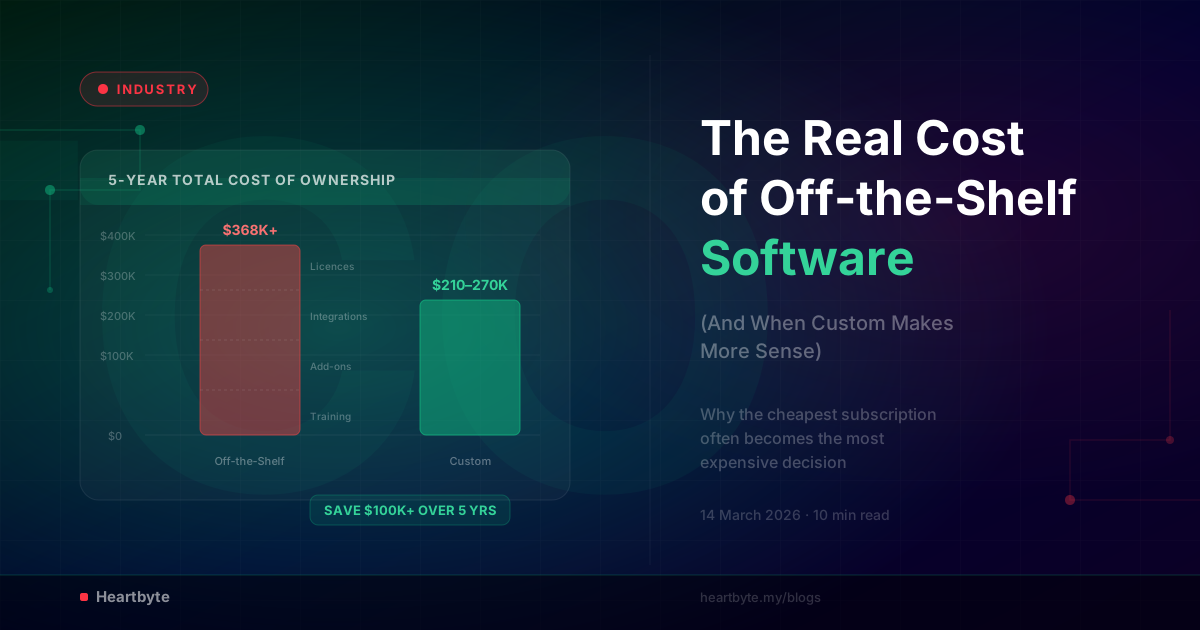
The upfront cost is higher, and there's no point pretending otherwise. But the shape of the cost is different. Off-the-shelf costs keep climbing, while custom software costs level off.
A Realistic Cost Comparison
Take a realistic example: a mid-sized company with 40 employees.
Off-the-Shelf (5-Year)
Custom Software (5-Year)
The numbers tell a clear story. Off-the-shelf costs less in year one, but over five years the custom option can save $100,000 or more. And that's before you count the time your team gets back once the workarounds and manual steps are gone.
This isn't a rule for everyone. The break-even point depends on how complex your workflows are, how big your team is, and how well the off-the-shelf product actually fits. But for any company with unusual processes or several systems to connect, the math almost always favours custom within a few years.
When Off-the-Shelf Still Makes Sense
This isn't a hit piece on off-the-shelf software. There are times when it's the right choice.
Early-stage startups
When you're still figuring out how you work, custom software is too early. Use off-the-shelf tools to move fast and prove your model first.
Standard, commoditised functions
Email, calendar, basic HR payroll, and simple accounting are solved problems. Building your own version of these rarely makes financial sense.
Short-term or temporary needs
If you need a tool for six months while you test a new market or run a short project, building your own doesn't make financial sense.
Low complexity, few integrations
If your team is small, your workflow is standard, and you don't need to connect lots of systems, off-the-shelf will serve you well without the hidden costs piling up.
Being honest about when off-the-shelf works is what makes the case credible for when it doesn't. The goal isn't to avoid commercial software altogether. It's to make the right choice for your own situation.
When Custom Software Is the Better Investment
Custom software becomes the clear winner when one or more of these apply to your business:
Your business processes are unique
If your approval flows, pricing rules, or day-to-day workflows don't fit neatly into any product on the market, you'll spend more time fighting the software than using it. Custom software bends to your process, not the other way around.
You're running multiple disconnected systems
If your team hops between three or four tools every day, exporting from one, importing into another, reconciling in a spreadsheet, that's a sign you've outgrown the off-the-shelf approach. One custom system can replace the whole chain.
Manual operations are eating your capacity
If your team spends real hours on tasks that should be automated, like building reports, updating records across systems, or chasing approvals, custom software can wipe those hours out. The payback is fast and easy to measure.
You need to scale without scaling costs
With per-user licensing, your software cost grows every time you hire. Custom software breaks that link: 20 users or 200, the system cost stays flat. For a growing company, that's the difference between software that drains money and software that builds value.
The question isn't "build or buy." It's "what will this actually cost us over the next five years, and which option gives us a system that works the way we work?"
The Most Expensive Software Is the One That Doesn't Fit
Off-the-shelf software isn't expensive because of its price tag. It gets expensive when it doesn't fit, when every gap between how it works and how you work costs you time, workarounds, and subscription fees that keep climbing.
Custom software isn't cheap, but it's an investment that pays you back over time. Every job you automate, every workaround you kill, every hour your team doesn't spend fighting the tools is a return off-the-shelf software can't give you.
If you're about to sign a five-year SaaS contract, take a week to work out the real TCO. Add up the integrations, the workarounds, and the lost time. Then compare that number to what a custom build would cost.
You might be surprised which option is actually the expensive one.
Stop paying for software that doesn't fit your business.
We build custom systems that replace workarounds with automation, designed around the way your company actually works.
Talk to Us About Your ProjectHeartbyte Team
Heartbyte is a bespoke software development company based in Malaysia. We build web, mobile, and custom software for ambitious businesses — with 15+ years of combined engineering experience and zero change request fees, guaranteed.