

Vibe Coding Is a Drug. It Feels Amazing. Until It Doesn't.
A new species of developer is shipping production code without understanding it. AI is a 10× multiplier for senior engineers — and a 10× crutch for everyone else. Here's what scale exposes.
Heartbyte Team
Engineering & Strategy
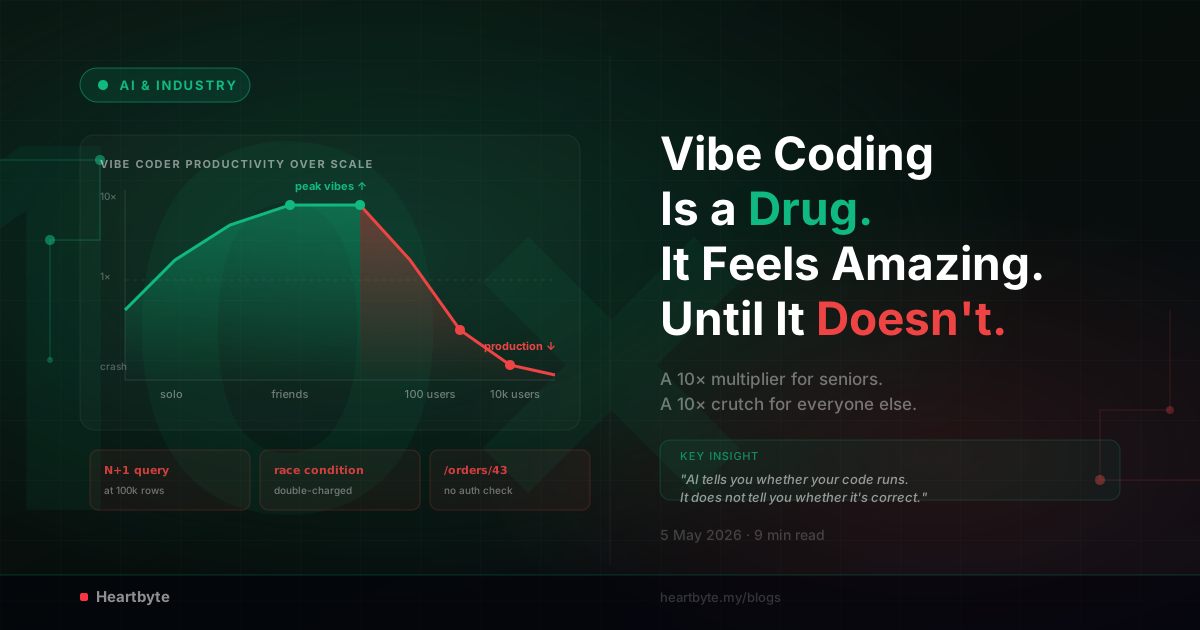
There's a new kind of developer all over GitHub right now. They don't read the docs, they don't write tests, and they couldn't explain the runtime if you asked. They tab through Cursor, Copilot, or v0, accept whatever pops up, and ship it. Six hours of "work" gives you something that looks like a real product. They call themselves "vibe coders," and more and more, people say it like a compliment.
For one group, this is the best thing that's ever happened to software. For another, much bigger group, it's the start of a problem they don't know they have yet.
"AI is a drug. Used right, it's a stimulant. Used wrong, it's a substitute for thinking."
Both can be true at once. The real question is which one you're running on, and what happens to your project the day easy mode runs out.
The 10× Engineer Is Real Now
For senior engineers who already know what good architecture looks like, who've spent years debugging production incidents and can read a stack trace and spot the bug three layers down, AI really is the productivity boost the marketing claims.
They use AI like a surgeon uses a scalpel, a tool that makes careful work faster. They know what they want before they ask, and they read the output with a sharp eye. When the model gets something slightly wrong, a missing edge case or a memory leak or a race condition, they catch it in seconds, because they've made that exact mistake a hundred times in their own pre-AI code. Old production fires left scars, and the scars do the catching.
This is the 10× engineer the industry has argued about since the 1980s. AI didn't create them. It just handed them a louder amplifier.
What "Vibe Coding" Actually Is
Then there's the other group. The ones who never built the foundation.
Definition
Vibe coding : writing software by telling an AI model what you want, accepting whatever code it spits out, and shipping it without really understanding what the code does, why it works, or when it'll break.
A vibe coder isn't just someone who uses AI. Every good engineer uses AI now. A vibe coder is someone who uses AI instead of understanding, leaning on the model to stand in for years of experience they haven't put in yet.
The output looks shockingly good. The MVP works. Friends who try it say "wow, you built that?" For a small tool, a personal app, a hackathon entry, or a 50-user side project, vibe coding is fine. Better than fine. It lets people who'd never have shipped anything actually ship something. On its own terms, that's a real win.
Where the Drug Metaphor Comes From
AI feels good to use. That's the part nobody warns you about.
You type a request, code appears, it runs, it works, you feel like a wizard. Then you do it again. And again. Each round is short, full of dopamine, and almost no effort. The loop that took five hours before AI now takes five seconds. Your brain notices. It rewires.
"You can build anything. Until you have to debug it. Or scale it. Or change it. Or explain it to another engineer."
After a few months of this, something quiet has happened. The things you used to know, what a deadlock is, why a query is slow, what happens when two users hit the same endpoint in the same millisecond, start to feel like useless trivia. Why memorise it when the model knows? Why understand the thing when you can just ask?
This works fine, right up until it doesn't. And the moment it doesn't, you find out the muscles you never built are the exact ones the situation now needs.
The Solo-Project Window Is Real
Let me be careful here. Vibe coding isn't a sin. It has a real, even powerful use, and pretending it doesn't is just gatekeeping.
Where the lines actually are:
Vibe coding is fine
- ✓ You and a handful of friends are the only users
- ✓ The data isn't valuable enough to attack
- ✓ Downtime costs nothing real
- ✓ You're prototyping before validating
- ✓ You'll never need to change it again
Vibe coding stops being fine
- ✗ A real customer pays for it
- ✗ Another engineer has to work in the codebase
- ✗ Traffic doubles, then doubles again
- ✗ Someone tries to abuse it
- ✗ Something breaks at 3am
For everything in the green column, AI-only is the right call. "Doing it properly" costs more than the system is worth. Building a wedding invitation site? Vibe-code it. A weekend tracker for your gym friends? Vibe-code it. A throwaway internal tool that replaces one Excel sheet? Vibe-code it. Have fun.
Then Scale Happens
The moment something built on vibes starts to grow, the trouble that was always there shows up. None of it is new. It was just hidden until the conditions were right to expose it.
What scale exposes, and what the vibe coder didn't know:
A query that ran in 2ms with 10 rows takes 8 seconds with 100,000.
The vibe coder doesn't know what an index is, why the AI didn't add one, or how to read an EXPLAIN plan. Their fix: ask the AI for "performance improvements." It adds caching everywhere. The query is still slow.
Two users hit "checkout" at the same millisecond. Both get charged.
The vibe coder hears the words "race condition" for the first time after losing customers. The model never warned them, because they never asked, because they didn't know it was even a thing.
A user changes the URL from /orders/42 to /orders/43 and sees someone else's data.
The vibe coder didn't know authorisation is a separate thing from authentication. The AI built a "login" feature, and nothing in there checks whether this user is allowed to see that record.
Memory usage climbs every hour until the server crashes at midnight.
The vibe coder restarts it every day and calls that "uptime." The real leak, maybe a forgotten subscription or a connection that never closes, is buried in a function the AI wrote and the vibe coder has never read.
The frontend feels slow. The AI suggests caching. The vibe coder agrees.
Now it's slow and shows stale data. The vibe coder asks the AI to fix it. The AI adds more caching, with longer TTLs, in more layers. The bug just gets bigger.
Every one of these is a problem an experienced engineer would have seen coming before writing the first line. Not because they're smarter, but because they've been bitten by all of them and they remember the bite. The vibe coder hasn't been bitten yet. The product has.
The Hidden Cost of "It Works"
The dangerous thing about vibe coding isn't that the code is bad. A lot of it isn't, on the surface. The real danger is that the developer can't tell either way.
You can ship something that runs perfectly on your machine, demos beautifully, and passes every test you wrote, and still can't handle 10× the load. There's no warning light. The model doesn't say "by the way, this falls over at 1,000 users at once." It just gives you code that works for the test you actually ran.
"AI tells you whether your code runs. It does not tell you whether your code is correct. Those are different questions."
When the system finally breaks under real load, the vibe coder is in the worst spot possible: a codebase they didn't write, a problem they don't recognise, and an AI that confidently hands them patches that cover the symptom while the real issue gets worse. The dopamine loop that built the product can't fix it. The same thing that made the build feel easy makes the debugging feel impossible.
How to Tell Which Side You're On
What matters here isn't how often you use AI. It's what happens when you switch it off.
Could you build this without AI?
Not "would you want to." Could you. If the model went down for a week, would the project stall, or would you keep going, slower but still going? If it would stop dead, then AI isn't your tool. It's holding you up.
Can you predict what the AI will say before it says it?
Senior engineers can roughly guess the output before they hit enter. They use AI to skip the typing, not the thinking. If the model keeps surprising you, you're being taught, which is good, but you're not the one driving yet.
When the AI makes a mistake, do you catch it?
Not after the bug bites you in production. Before you commit. Catching the mistake is the skill. AI gets you 90% of the way there. The 10% it gets wrong is where the bugs live, and reading that 10% right is the only thing between fast and broken.
Can you explain why this works?
Pick a function in your last AI-written project. Walk through it line by line. Say why each part is there. If you can't, the code isn't really yours. You're just renting it.
What did you do the last time something scaled?
Or have you ever had something scale at all? Not in theory, but in production, with real users and logs and pages at 2am. That experience is the line between using AI as a boost and using it as a crutch, and there's no shortcut to it.
The Senior Who Vibes vs. The Vibe Coder Who Pretends
On screen, the two look the same. Both write working code and ship MVPs in a weekend, and from the outside you can't tell them apart.
The difference shows up six months later.
Six months later — senior
Steps back into the codebase. Understands it. Cleans up the slow query. Adds the missing index. Hands a module to a junior to build on. The system grows in the right direction.
Six months later — vibe coder
Opens the codebase. Doesn't recognise it. Asks the AI to "make it stop crashing." Each fix piles on more mess without touching the real problem. In the end the only way forward is a rewrite.
"The senior engineer's AI prompts get shorter over time. The vibe coder's get longer. That's the entire pattern in one sentence."
AI Doesn't Replace the Years
What nobody selling AI tools will tell you is that the years of pain still matter. The all-nighter chasing a memory leak. The migration that took down production at 4pm on a Friday. The customer ticket where the bug turned out to be one missing await. Those become instinct. AI speeds up the typing, but it can't hand you the experience.
For solo projects, hackathons, and personal tools, none of this matters. Vibe-code your way to anything. Have fun. Ship things you couldn't have shipped before. That's a real win, and treating it like one isn't betraying the craft.
But the moment you tell yourself the vibes will scale, the moment a real customer leans on your system, the moment a teammate has to read code you don't really understand, the drug stops being free. The bill comes, and the only people who can pay it without a rewrite are the ones who built something before AI made it easy.
"Use AI like a stimulant, not a substitute. The first makes you faster. The second makes you fragile."
Building something that has to actually scale?
We use AI all through our work too, but the architecture, the security, the database design, and the production fires are still owned by engineers who've been through them before. That's what decides whether your system survives growth or breaks under it.
Talk to Us About Your ProjectHeartbyte Team
Heartbyte is a bespoke software development company based in Malaysia. We build web, mobile, and custom software for ambitious businesses — with 15+ years of combined engineering experience and zero change request fees, guaranteed.