

Why Hidden Change Request Fees Are Killing Your IT Projects
The dirty secret of the IT industry that no agency wants you to know — and why the $0 CR fee model is the future of ethical, client-first software development.
Heartbyte Team
Engineering & Technology
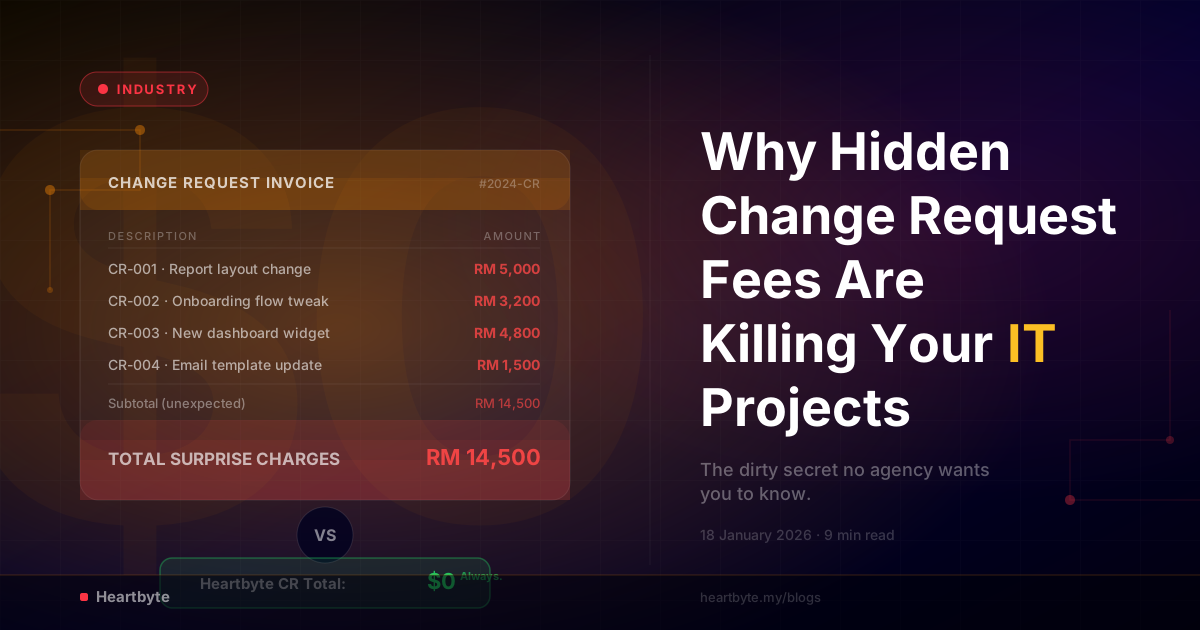
Picture this. You've hired a software agency to build your new system. You signed the contract, agreed on a price, and got the project going. Three months in, you're excited. The system is coming together and you can finally see what's possible.
Then you have a new idea. A small tweak to how the reporting works. Maybe a different flow for sign-up now that you've seen how the system feels to use. Totally fair. It's your system, and you're improving it now that you actually understand it.
Your project manager gets back to you with a quote. RM5,000 for the reporting change. RM3,200 for the onboarding tweak. CR-001 and CR-002.
Welcome to the change request fee trap.
What Are Change Request Fees?
A change request (CR) fee is what many software agencies charge when you ask for any change that falls outside the original scope document. On paper it sounds fair. You agreed on X, you're now asking for Y, and Y costs extra.
In practice, it's one of the most anti-client ways to bill in this whole industry. And somehow everyone treats it as normal.
The Original Sin: Scope Documents Are Incomplete by Nature
Few agencies will tell you this upfront, but the first scope document is always incomplete. Not because your project manager is bad at the job, and not because you didn't think it through. It's because building software is how you figure out what you need. You can't fully know what you want before you've seen what's being built.
Think about what you're being asked to do. You have to describe, in detail, a system you've never used, built on tech you might not understand, solving problems that only get clear once the work starts. So you do your best. You write a requirements document and answer every question they ask.
But the moment you see the first working version, you know things you didn't know before. A flow that needs changing. A feature you thought you wanted that turns out wrong. Something important that nobody put in the original scope.
This isn't failure. It's just how building software works.
Every experienced engineer and every honest agency knows it. CR fees punish you for it. They charge you for the gap between what you could describe before you saw anything and what you understand once you've seen something real.
How CR Fees Become a Business Model
The kind way to explain CR fees is risk. Agencies want to protect themselves from clients who keep adding more and more, burning developer time without paying for it. Scope creep is a real problem, and the worry is fair.
But in practice, CR fees stop being protection and turn into a way to make money.
Agencies know clients will find gaps during the build and get new ideas as the system takes shape. So instead of pricing that in from the start, they scope it narrow on purpose. They know the real money comes later in CRs.
The typical pattern looks like this:
Agency quotes RM80,000 to win the contract. A low, attractive number.
The build starts. Scope gaps show up, like they always do, and each one means another CR invoice.
By the time it's done, the project costs RM110,000–120,000. Every "small change," a different button flow, a tweaked report, a new field on a form, got billed on its own.
The agency quoted low to win and made their real money on CRs. The client feels played, and they were.
The Hidden Costs Beyond the Invoice
The money you lose to CR fees hurts, but at least you can see it. The hidden costs are often worse, and they pile up as the project goes.
Project paralysis
When every new idea costs RM3,000, clients stop having ideas. They stop improving things and stop pushing for the system their business actually needs, because every push costs money they didn't budget for. You end up with a system that's "done" but not good enough. Shipped on time and still not right.
Relationship breakdown
Nothing kills a client-agency relationship faster than surprise invoices. What should be a team working together turns into a fight over money. Clients start reading every message thinking "will this cost me a CR?" Engineers stop being partners and start guarding the gate. Trust drains away, and it rarely comes back.
Scope shrinkage
Under CR pressure, clients start settling for less. They drop ideas that would really improve their system, and tell themselves "it's fine" when it isn't, because pushing back means another invoice. The end product comes out smaller than it should have been, and nobody's really happy about it.
Delayed business value
Every CR needs a quote, an approval, a purchase order, and a new sprint. A change that could ship in three days gets held up two weeks by paperwork. Your business moves slower, not because the work is hard, but because of how you're billed.
The Real Problem: Everyone Wants Different Things
The money costs are real, but the deepest problem with CR fees is how the whole setup works.
When an agency charges for change requests, they make more money from more change requests. A clean project that runs straight to the finish earns them less than one that throws up five CRs along the way.
That's a bad setup. The agency makes money from things being unclear. From vague scope documents, missing requirements, and not asking the right questions upfront. Every gap in the original spec turns into money they can charge for later.
"We're not saying agencies wreck their scope documents on purpose. But when you make money off scope gaps, you stop trying so hard to close them."
So you and the agency end up wanting opposite things. You want fewer CRs. They earn more with more of them. You can't build a real partnership on that.
Why Discovery During Development Is Normal — and Should Be Free
There's a basic truth about building software that most sales teams won't tell you.
Requirements that look clear on paper often turn out to be messy once you start building. A data model that looked simple in a spreadsheet needs three more fields to work. A user flow that seemed obvious on a wireframe trips people up when real users touch it. A report that looked easy turns out to need a totally different setup underneath.
Finding these things out isn't bad planning. It's what happens when you go from words on a page to real, working software. It happens on every project, for every client, at every decent agency.
The only difference is who pays for it.
At agencies with CR fees
- ✗ Client pays for every discovery through surprise invoices
- ✗ Every small change needs a formal approval first
- ✗ Client learns to hold back ideas to dodge fees
- ✗ Final product is smaller than it should be
At Heartbyte
- ✓ Discovery is part of the service, no extra charge
- ✓ Changes happen on the spot, no paperwork
- ✓ Clients are encouraged to push for what's right
- ✓ Final product is what the business actually needs
The $0 CR Fee Model: How It Actually Works
When we tell clients that Heartbyte charges $0 for change requests, the first question is always: how do you make money?
The answer is we price for the real work from the start. We scope honestly and price for the whole job, changes and all, because we know good software changes as you build it.
What we don't do is quote low to win the job and then make our money on CRs. That works for a while and then wrecks the relationship. We've seen it happen, so we do it differently.
There are limits, of course. Zero CR fees covers changes, feature tweaks, and reasonable updates to the original brief. It doesn't mean endless new features with no effect on time or budget. If you want to grow the project a lot, like adding a whole new module or changing direction, that's a talk about a new project, not a change request.
But the tweaks and changes that come up in any normal software project? Those are part of the service. Always.
Red Flags to Watch For When Hiring a Dev Agency
If you're picking a software agency, watch for these before you sign anything.
Red flags
- — CR fees explicitly written into the contract, often as a percentage of your daily developer rate
- — Vague scope documents that list features but never say how they actually behave or handle edge cases
- — They push back on changing things as you go, wanting everything locked before a single line of code gets written
- — No way to keep improving things once the build starts, just a "submit a ticket" culture
- — Everything goes through account managers, with no direct line to the engineers building your system
Green flags
- + An open, upfront talk about how changes get handled, before you sign
- + A build process that plans for changes and improvements as part of the work
- + A direct line to the engineers, not just account managers managing expectations
- + A track record of clients who kept working with them long after delivery
- + Honest, clear lines on what's included and what's actually new scope, with no hidden grey areas
The Future Is Client-First
CR fees exist because the software industry has always held more cards than its clients. The tech is hard to follow, so clients don't know enough to tell when they're being overcharged, or when a "necessary" change request was really a gap the agency should have caught.
That's changing. Clients know more now, and word gets around. The agencies that earn real trust, by treating clients as partners instead of a way to make money, are the ones building businesses that last on word of mouth.
Zero change request fees isn't a gimmick or a loss-leader. It puts us on the same side as you, so we only do well when you do. When your system ends up doing what your business actually needs, that's the win we were both after.
You shouldn't have to pay extra for the software to become what it was always supposed to be.
That's the only model that makes sense to us. And it's what we've built our entire practice around.
Start a Project — $0 CR Fees, GuaranteedHeartbyte Team
Heartbyte is a bespoke software development company based in Malaysia. We build web, mobile, and custom software for ambitious businesses — with 15+ years of combined engineering experience and zero change request fees, guaranteed.