

Why More Programmers Won't Speed Up Your Project
Software development isn't an assembly line. A focused 3-person team can outperform a 20-person IT department, and traditional companies keep getting this wrong.
Heartbyte Team
Engineering & Technology
Every old-school company seems to run on the same gut instinct. If the project is behind, hire more developers. If the system needs to be built faster, throw more people at it. More programmers means faster delivery. Simple maths, right?
It's wrong. And this one mistake has probably cost companies more money and more time than any other call in IT.
Nine women can't make a baby in one month. And twenty programmers can't build a system faster than three who actually know what they're doing.
The Assembly Line Fallacy
When a factory needs to make more units, it hires more workers. When a building site is behind, it brings in more labourers. The logic is simple: more hands, more output. For instruction-based work, the repetitive jobs where each person follows a clear set of steps, that logic holds.
The part traditional companies refuse to accept is that software development is not instruction-based work.
Building a new system isn't like putting a product together on a conveyor belt. You can't chop it into 20 identical tasks and hand one to each person. The work is all tied together. Every module talks to every other module, and one design decision can ripple into everything else. Each feature has to fit the overall flow.
Where more people actually helps:
Data entry and migration — clear, repetitive, no design decisions
Bug fixing on a stable system — isolated issues that don't affect each other
Content updates and template changes — follow instructions, no design thinking
Where more people makes things slower:
New system architecture — more opinions, more conflicts, slower consensus
Feature design and flow planning — needs one clear vision, not twenty inputs
Client requirement translation — requires deep understanding, not distributed guesswork
Manpower Was Never the Bottleneck. Thinking Is.
When a company hires a team to build a new system, the hard part isn't writing the code. The hard part is everything that happens before the code gets written.
Understanding the business
You need to sit with the client, learn how they run things, and see how their team works day to day. You don't get the real pain points from a requirements document. You get them from watching people fight with the process they have now.
Designing the architecture
How should the data flow? What should the database look like? How do the modules connect? What happens when one part breaks? These calls need a small group of experienced engineers who can hold the whole system in their heads.
Translating client ideas into technical flow
The client says "I want approval routing." But what does that mean in a system? Who approves? What kicks off the approval? What happens if it's rejected? Can it be pushed up the chain? Answering that takes back-and-forth talk, not more developers in a room.
None of this gets faster with more people. You can't split "figuring out the right design" across 20 people. Try it and nobody owns the vision, everyone pictures the system differently, and you end up with a patched-together mess of clashing design decisions.
Why 3 Engineers Beat 20
A small, focused team of three experienced engineers can move faster than a 20-person IT department for one reason: the cost of talking to each other.
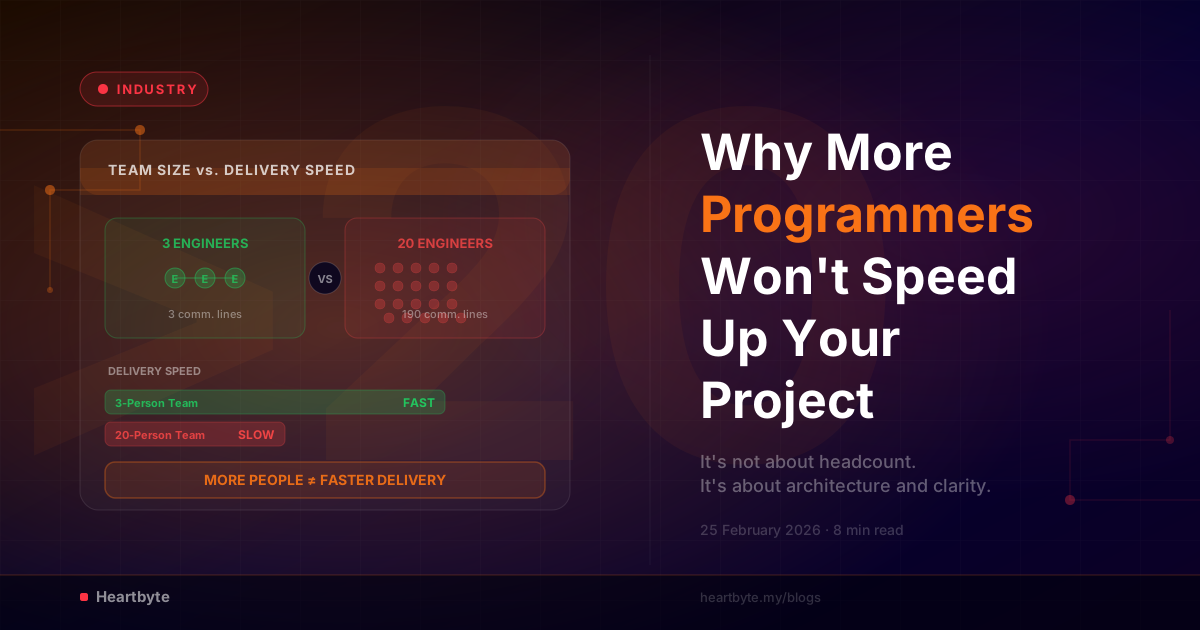
With 3 people, there are 3 lines of communication. With 20 people, there are 190. That's the actual maths, not a figure of speech. Every person you add multiplies the conversations, the meetings, and the chances to misunderstand each other.
3-Person Team
- ✓ 3 communication lines
- ✓ Everyone shares the same picture of the system
- ✓ Decisions made in minutes, not weeks
- ✓ Every engineer understands the full picture
20-Person Team
- ✕ 190 communication lines
- ✕ Everyone understands a different piece
- ✕ Layers of meetings and approvals
- ✕ Nobody owns the whole vision
In a small team, when someone wonders how the payment module should work with the notification system, they turn to their teammate and ask. The answer comes in 30 seconds. In a 20-person team, that same question turns into a Slack thread, a meeting invite, a documentation request, and a two-week wait while "the other team" reviews it.
The Real Work: Turning Ideas Into Systems
Most old-school companies miss the most valuable part of the whole thing: the translation.
A client comes to you with an idea. "We want an inventory system." Simple enough, right? But that one sentence hides a mountain of stuff nobody said out loud. How do they handle inventory today, by hand or with spreadsheets? Who approves what? Who needs to see what? What happens when stock runs low, and do different branches run different rules?
A good team doesn't just build what the client asks for. The real job is to work out what the client actually needs, then turn that into a flow that makes sense in a real system.
The client knows their business and the engineers know systems. The real work happens in the conversation between the two, not in how many people are coding afterwards.
This is the part that needs senior engineers who can sit with the people involved, ask the right questions, push back on assumptions, and offer answers the client never thought of. It needs people who see how every piece connects, who've built enough systems to know what works and what doesn't.
None of that gets better with more people. A room of 20 people talking about approval workflows won't beat 2 senior engineers and 1 product-minded lead having a focused chat with the client.
Clients Need to Accept: The System Flow Won't Match the Manual Process
Nobody likes to bring this part up.
When a company has done things by hand for years, with paper forms, Excel sheets, WhatsApp approvals and manual data entry, they expect the new system to copy their current process exactly. "We want it to work the same way, just digital."
But that's almost never the right approach.
Why the flow has to change:
Manual processes have shortcuts — people skip steps, make judgement calls, and deal with odd cases on the fly. A system can't copy a gut feel. It needs clear rules and set paths.
Data needs structure — a spreadsheet lets you put anything anywhere. A database needs things to be consistent. Moving to a system means tidying up what used to be loose.
Systems open up new options — things you couldn't do by hand (live dashboards, automatic alerts, audit trails) suddenly become possible. The flow should be redesigned to use what the system can do.
Efficiency means cutting the fat — the whole point of building a system is to get rid of wasted steps. If the new system copies every twist and turn of the old manual process, you've just built an expensive digital version of the same mess.
A good team will push back on "make it exactly like our current process." Not to be difficult, but because their job is to build something better than what was there before. That only works if the client trusts the team and accepts that some workflows will have to change.
The best systems don't mirror old processes. They reimagine the workflow and take the business further than the manual version ever could.
What Actually Makes Projects Move Fast
If more people isn't the answer, what is? After years of building systems, four things speed delivery up every time:
A small team with deep context
Two or three engineers who get the whole system and the client's business will make faster, better calls than a department of specialists who each only see their own piece.
Direct client access
When the developer building the feature can talk straight to the person who'll use it, questions get answered in minutes instead of days. No project managers playing telephone, no requirement documents that lose half their meaning on the way through.
Clear architecture from day one
Spend time upfront getting the structure right. A well-built foundation is fast to build on. A bad one slows everything down no matter how many people you throw at it.
A client who trusts the process
When a client is open to new flows, trusts the team's advice, and gets that a digital system shouldn't be a carbon copy of their manual process, everything moves faster. Working together beats micromanaging every time.
Stop Counting Heads. Look for Clarity Instead.
Next time someone tells you their IT project needs more developers to hit the deadline, ask them this: does the team have a clear plan everyone understands, and can they talk to the client directly?
If the answer is no, adding more people only makes the chaos worse. The project doesn't need more developers. It needs more clarity, and fewer people making better calls instead of more people making confused ones.
At heart, building software is creative design work. It's closer to designing a building than putting a car together. You don't speed up a building's design by hiring 50 architects. You speed it up with the right 3 who share a vision and know what they're building.
You don't measure a great development team by its size. You measure it by how much of the system each member can hold in their head, and how fast they turn business needs into working software.
Your project doesn't need more developers. It needs the right ones.
At Heartbyte, we keep our teams small, our communication direct, and our builds clean. We sit with you, learn your business, and build systems that make sense in real life, not just ones that work on paper.
Talk to Our TeamHeartbyte Team
Heartbyte is a bespoke software development company based in Malaysia. We build web, mobile, and custom software for ambitious businesses — with 15+ years of combined engineering experience and zero change request fees, guaranteed.