
Everyone Can Build an App Now. So Why Isn't Everyone Rich?
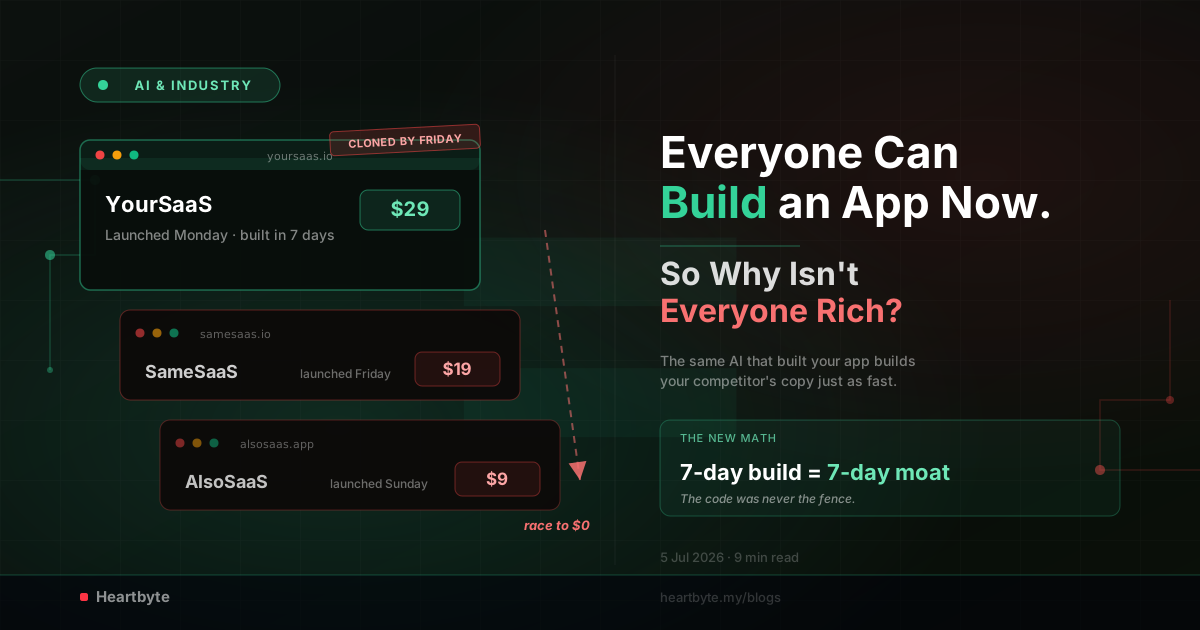
Last time we did the math on the vibe coding guru. This time, let's say he's telling the truth and you really can ship a SaaS in seven days. So can everyone else. A seven-day build buys you a seven-day head start, and the moat has to come from somewhere else.
Heartbyte Team
Engineering & Strategy
A while back we wrote about the vibe coding gurus, the ones leaning on rented Lambos and selling $497 courses about the $30K/month SaaS they built in seven days. We did the math on why the course is the real business. If you haven't read it, start there.
Today let's be generous. Assume the guru is telling the truth. The course works, the AI delivers, and you really do ship a working SaaS in seven days. You launch, you post it everywhere, your first users sign up. Now come with me to week two, because week two is where the real lesson starts.
"If AI can build your app in seven days, it can build a copy of your app in seven days. You didn't buy a moat. You bought a seven-day head start."
The wall that kept competitors out is gone
For thirty years, the hardest part of a software business was building the software. You needed engineers, money, and a year or two of patience. Most people had none of those, so most ideas died in a notebook. That wall was painful, but it did something valuable for anyone who got over it: it kept everyone else out. If you spent RM800K and a year building your system, a competitor had to spend roughly the same to catch you. The code itself was the fence around the business.
AI tore that wall down. We think that's mostly a good thing, and we use these tools every day. But notice what else happened. A wall only protects you if other people can't get over it. Now everyone who watched the same TikTok as you can get over it in a weekend. The same tool that made your app cheap to build made it cheap to copy. It works in both directions, at the same speed.
Week two: the clones show up
Play the tape forward. You launched a real product, people are paying, and your landing page is public. What happens next?
The clone timeline:
Day 1 — You launch.
Product Hunt, a few tweets, maybe your own TikTok. Twelve sign-ups. It feels incredible.
Day 4 — You become someone's prompt.
A stranger screenshots your landing page and pastes it into Cursor: "build me this." Nothing personal. You're item #14 on their list of AI SaaS ideas.
Day 9 — The clone launches.
Same features, cleaner pricing page, half your price. They can afford it. Their build cost was a weekend and a $20 subscription, same as yours.
Day 30 — The search results fill up.
Nine near-identical products, all with the same AI-written landing page. Buyers can't tell you apart, so they sort by price. Every week the cheapest one is someone new.
We didn't invent that timeline. Look at Product Hunt or the app stores right now. Thousands of AI products that all do roughly the same thing, launched weeks apart, undercutting each other. When ten products look identical, price is the only thing left to compete on. And a price war between products that cost nothing to build only stops at zero.
"You can't win a building race when everyone builds at the speed of the same AI."
The moat was never the code
The flood makes something obvious that was always true. Pick any software company that makes serious money and ask what protects it. It was never the code. Grab's code could be rebuilt by any decent team. What can't be rebuilt over a weekend: the drivers, the riders, the licences, the data, and the habit millions of people have of opening that one app and no other.
The same holds at small scale. The accounting tool your business pays for isn't protected by clever code. It's protected by your five years of records sitting inside it and the pain of moving them out.
What AI can't build for you overnight
- ▸ Customers who already trust you. Trust adds up over years, not sprints.
- ▸ Deep knowledge of one industry's real problems, the kind you only get by working inside it.
- ▸ Data that gets more valuable every month you operate.
- ▸ Distribution. An audience that actually hears you when you launch.
- ▸ A track record of not losing anyone's money or data.
Every item on that list takes years. Which is why nobody sells a $497 course about them.
The guru already knows this
Now look back at the guru with fresh eyes. There are hundreds of vibe coding courses out there, and they're mostly identical. His still sells out. Why? Not the content. His course leaks onto Telegram within a week of every launch, and it doesn't dent him at all.
He sells anyway because 400,000 people follow him and a chunk of them trust him. That's his moat. An audience, built over years of posting. It's the one part of his business AI can't clone, and it's the one part he never teaches, because he can't hand it to you for $497 or any price.
"The guru sells you the part of the business AI can copy, and keeps the part it can't."
That's the real lesson hiding inside every one of these courses, and it's free. You just have to notice it.
So what's actually worth building?
If code can't be the moat, the moat has to exist before the code. That flips the whole order. It used to be: ideas are cheap, building is hard. Now building is cheap, and the question that decides everything is what you bring to the table before a single line gets written.
Starts with a moat
- ✓ Software for the business you already run: your customers, your data, your process
- ✓ A tool for an industry you've worked in for ten years
- ✓ Automation that feeds on records only you have
- ✓ Anything where the customer already knows and trusts you
Starts with nothing
- ✗ A to-do, notes, or invoice app aimed at strangers
- ✗ A wrapper around ChatGPT based on a trending TikTok
- ✗ Anything from an "AI SaaS ideas" listicle
- ✗ A clone of a product you saw on Product Hunt last week
This is why the boring answer keeps winning. A freight forwarder who ships software for freight forwarders starts miles ahead of any vibe coder, because the hard part isn't the app. The hard part is knowing which ten features matter and having fifty customers who'll take your call. AI can't generate either one. We've made the same point before from the engineering side: code is cheap now, software isn't, and coding was always the easy part. The market is now teaching the business version of that lesson, at scale, for free.
Building is the cheapest part now
None of this makes software worthless. The value just moved to a different place. When building stopped being the hard part, everything around the code got more important: the problem, the customers, the data, the trust. The people winning with AI tools are the ones who already had those, and just needed the building to get cheaper.
If you run a real business, that's good news. You already own a moat. You have customers, a process, years of industry knowledge, and data sitting in spreadsheets. The only thing that was missing is an affordable way to build on top of it. That's what AI changed. It's also the honest version of the guru's promise, and nobody can sell it to you, because you already have it.
"When anyone can build anything, the money goes to the people with something worth building on."
Already own the moat? Build on it.
We build custom software on top of what your business already has: your process, your data, your customers. Real engineers, fixed price, no $497 shortcuts. The building got cheaper. The judgement didn't.
Talk to Us About Your ProjectHeartbyte Team
Heartbyte is a bespoke software development company based in Malaysia. We build web, mobile, and custom software for ambitious businesses — with 15+ years of combined engineering experience and zero change request fees, guaranteed.