

If Vibe Coding Made Them Rich, Why Are They Selling You a Course?
The guru in the rented Lambo says AI built him a $30K/month SaaS in six weeks. So why is the entire business a $497 course? Here's the math nobody on TikTok wants to do, and what actually makes money with AI code tools.
Heartbyte Team
Engineering & Strategy
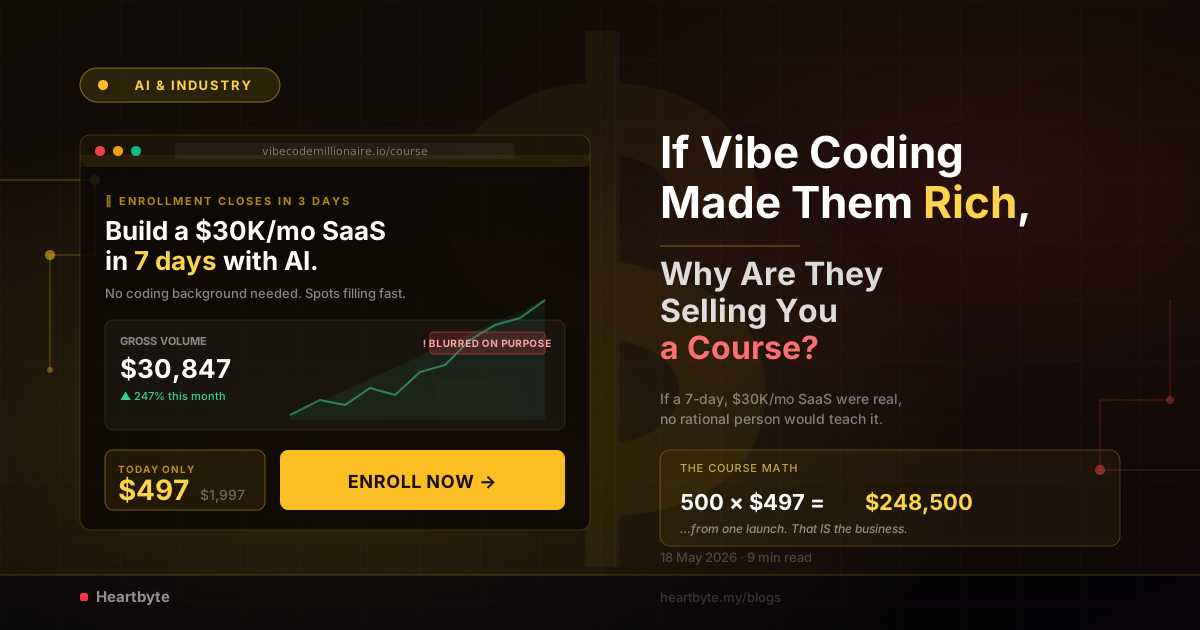
You've seen the video. He's leaning against a Lamborghini he didn't buy, in front of an Airbnb he doesn't own. The screen-record cuts to Cursor flying through code at 4× speed. There's a Stripe dashboard with the numbers blurred just enough to imply six figures. The caption says he built it in seven days. The voiceover says you can too — for $497. Pinned comment: "spots are filling up fast."
And part of you wants to believe it. Because it would mean the thing you've been told for years, that software is hard and engineering takes time and there's no shortcut, was a lie. It would mean the door is wide open and you just have to walk through.
"If a seven-day, $30,000-a-month SaaS were actually repeatable, the rational move is to build the next one, not to teach 500 strangers how to do it for $497."
That one sentence is the whole article. The rest is the math, because the math is the only thing that ever beats a good pitch.
Do the math with me
Take the guru at his word. He has a SaaS, AI-built, making $30K/month, with running costs near zero because "the AI does everything." That's $360K/year in roughly passive income. He says he built it in seven days. Let's assume that's true too.
So what would a sane person do, once they've found out they can spin up a $360K/year asset in seven days of work?
The decision tree he won't show you
- ▸ Option A: Build another one. Same skill, same speed. Now $720K/year. Repeat eight more times this year. End the year at $3.2M ARR with ten products. Sell one of them. Retire.
- ▸ Option B: Teach the method to 500 strangers for $497 each, creating 500 direct competitors who will compete with you in the exact niche you just proved is profitable.
- ▸ Option C: Spend most of your time recording TikToks in front of cars you don't own, instead of operating the $30K/month machine you just supposedly built.
He picks B and C. Every single one of them does.
Now do the course math. 500 students × $497 = $248,500, from one launch, with no churn, no servers to run, and no refund risk if the contract has the right wording. That isn't a side hustle to prop up the "real business." It is the real business. The screen-recordings of Cursor are the packaging, and the SaaS, if it exists at all, is the marketing budget.
The oldest pitch in commerce, retargeted
This is nothing new. It's one of the most reliable business models in history, and it's worn a lot of costumes.
The same template, different decades:
1849 — California
The richest men in the gold rush sold pickaxes, jeans, and maps. Almost none of them actually mined gold.
2005 — Real Estate
"No money down" property gurus made millions selling seminars, not properties. Their portfolios were the conference circuit.
2017 — Dropshipping
"6-figure Shopify stores" turned out to be 6-figure Shopify courses about stores. The store was a demo.
2026 — Vibe Coding
"AI-built $30K/mo SaaS" gurus selling $497 courses. The SaaS is a stage prop. The course is the business.
The only thing that changes is what's being sold. The pitch is the same, and so is the math: when a "secret method" really works, a sane person uses it. When it doesn't, they sell it. Almost everyone shouting on TikTok is selling.
Survivorship bias is the whole product
Say, to be generous, that one buyer in five hundred actually ships something profitable. The guru finds that one student, posts the testimonial, and tags them in the next launch ad. The other 499 never show up. The ones who shipped nothing. The ones whose product died in week three. The ones who got halfway through and realised they didn't know what authentication was. They go quiet. They tell themselves they "didn't do the work," and they blame themselves instead of the pitch.
Every course business like this runs on the quiet majority of students whose failure nobody sees. The visible 1% is the whole marketing engine. The invisible 99% is the actual product.
"You are not buying the success of the student in the testimonial. You are buying a lottery ticket whose odds are deliberately hidden from you."
We've cleaned up enough of these to know how the failure goes. The student watches eight modules, copies the course demo exactly, ships it, and gets two real users. The third user hits a bug. To fix it you have to read the code, and the student can't read the code, because the course never taught them to. That was the whole selling point. So they ask the AI. The AI patches the symptom, a new bug pops up, the student asks the AI again. By month three the codebase is a mess the student can't change anymore. By month six they've quietly stopped logging in.
They don't post about it. Of course they don't. Nobody posts the comedown.
What vibe coding actually produces
We're not anti-AI. We use these tools every day and we've shipped real systems with them. So this isn't a rant from someone whose job is under threat. It's a rant from someone who, more and more, gets paid to clean up what these courses produce.
Here's the honest timeline of an AI-built SaaS in the hands of someone whose only training is a $497 course:
A predictable lifecycle, every time:
Day 1 — Looks like magic.
The demo runs. Friends say "wow, you built that?" The dopamine is real. So is the screen-record for the next launch ad.
Month 1 — The first 20 real users.
Edge cases show up that the AI never planned for. The "founder" copies the bug into the AI, asks it to fix, and pastes the result back. Sometimes it works. Sometimes it creates a quieter, worse bug.
Month 3 — The codebase becomes a stranger.
Three months of "make the AI fix it" have produced code the founder doesn't understand. Each new feature now takes longer than the whole original build did. The dopamine has flipped into dread.
Month 6 — The phone call.
A real customer's data leaked, or Stripe is asking compliance questions, or two users got charged at the same time. The founder calls a real engineer, who says "we'd have to rewrite this." That $497 course just got very expensive.
We've written about this from other angles: why scale breaks vibe-coded systems, why hackers love them, and why the part that wasn't code just got more expensive. The guru selling the course won't bring any of this up, because the course can't survive it.
Who actually makes money with AI code tools
AI coding tools aren't a scam. They're the biggest productivity boost software has ever seen, and they've already made a lot of people very rich. But the people getting rich on them look almost nothing like the people in the TikTok ads.
Quietly winning with AI
- ✓ Engineers with 10+ years of pre-AI experience
- ✓ Founders who hire those engineers
- ✓ People with real domain knowledge and a real problem
- ✓ Anthropic, OpenAI, Cursor, GitHub — the picks-and-shovels
Loudly "winning" on TikTok
- ✗ People with no prior engineering work to show
- ✗ "Founders" whose only product is the course
- ✗ Stripe dashboards with blurred numbers
- ✗ Calendars full of "spots filling fast"
Notice the pattern. The people who actually make money with AI tools are too busy running their business to film TikToks about it, and the people filming TikToks are too busy filming to run anything. There's almost no overlap, because both eat the same hours.
The five questions that end the pitch
You don't need to be technical to take one of these courses apart. You need five questions. Send them to the guru's DMs before you pay, and watch what happens.
What is the live URL of the SaaS you supposedly built?
Not a screenshot. The real, public, paying-customer URL. If it doesn't exist, or "can't be shared for competitive reasons," then the SaaS doesn't exist either.
Can I see your unblurred Stripe MRR and churn rate?
Real founders show their numbers. Course-sellers blur them. There's no "competitive" reason to blur MRR, since your competitors already know roughly what you make. A blurred dashboard is just for show.
Where is the GitHub repo, even private under NDA?
A real seven-day vibe-coded SaaS has a git history. The commits show the truth: when it was built, by whom, and how fast. No real engineer is scared of a code review. People hide what they don't have.
Of your last 100 students, how many shipped a profitable product?
Not "finished the course." Shipped. Profitable. With names. If the answer is "we don't track that" or "results vary," you're looking straight at the survivorship-bias machine.
If this method works, why are you teaching it instead of running it?
The honest answer is some version of "because the course makes more money than the method." That's fine, but it changes what you're buying. You're paying for access to the seller's audience, not for your own result.
We've sent these questions a few times for friends who were about to buy. It always goes the same way. The guru ghosts, or sends back a "this is too negative, I can tell you're not ready" reply, or quotes a clause from the course terms about not sharing client info. None of that is what a real operator would say. A real operator would either show you the receipts, or politely tell you he doesn't owe you the receipts before you've paid, and you'd respect that and walk away.
The honest version of the AI productivity story
AI didn't kill the need for engineering. It just cut down the typing. The thinking, the judgement, the architecture choices, the security, the threat model, the calls about what not to build, none of that got cheaper. If anything it's more visible now, because all the typing used to hide it.
That's good news. It means a small team of people who can think, three or four or five engineers who have shipped real systems before, can now ship like a team of twenty. We see it in our own work. The boost is real, and so is the money it makes. None of it needs anyone to pretend a seven-day SaaS is a real business.
"AI made software cheaper to start and just as expensive to operate. The course-sellers price the first half and hide the second."
The cheapest course in the world
Here's what we'd actually tell a friend who wanted to learn to build with AI. Don't pay $497. Don't pay anything. Open Cursor and the docs. Pick a real problem in your life, like your team's invoicing, your gym's class schedule, or your side-project's CRM, and build it. When it breaks, read the error and ask the AI what it means. Then read the AI's answer instead of just accepting it. Do that for six months.
After six months you'll still be a worse engineer than a senior with ten years behind them. But you'll be ten times more useful than someone who bought a course, watched eight modules, and shipped a demo. The only thing in the way for most people is the willingness to not take the shortcut.
The guru's whole job is to sell you the belief that the shortcut is real. It isn't, and that's the boring, free truth behind every solid career. Real money in software still comes from really understanding it. AI made that understanding faster to pick up. It didn't make it optional.
"Anyone genuinely making $30K a month from a vibe-coded SaaS is operating it. The ones telling you how to do it are operating you."
Got something you'd rather build than buy a course about?
We use AI tools every day, but the architecture, the security, the database design, and the calls about what not to build are still owned by engineers who've been through it. Fixed price. Real engineers. No "spots filling fast." Just software that's still standing past month three.
Talk to Us About Your ProjectHeartbyte Team
Heartbyte is a bespoke software development company based in Malaysia. We build web, mobile, and custom software for ambitious businesses — with 15+ years of combined engineering experience and zero change request fees, guaranteed.