

AI Rewards Problem Solvers. It Punishes Everyone Else.
Give two developers the same AI and the same bug. One ships the fix before lunch. The other is still pasting error messages at 6pm. The tool is identical. The thinking behind it isn't, and that thinking just became the most valuable skill in software.
Heartbyte Team
Engineering & Strategy
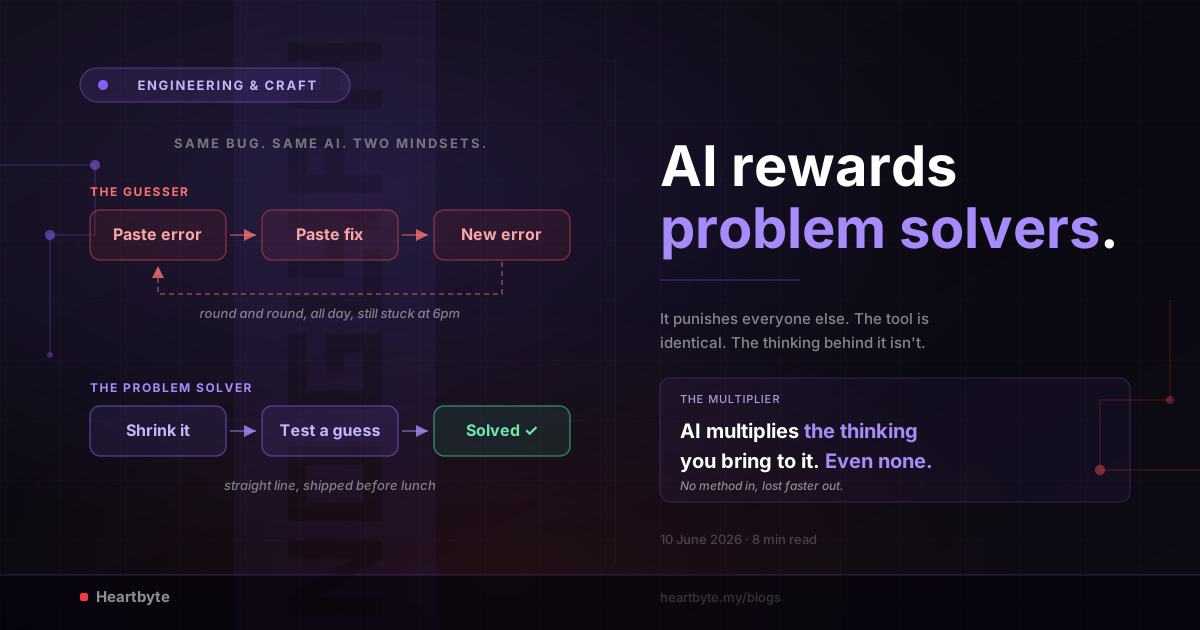
Everyone assumed AI would close the gap between developers. The weak ones get pulled up, the strong ones matter a little less, and we all end up about the same. The opposite happened. The gap got wider, because AI multiplies whatever thinking you bring to it. Bring a clear method and you get scary fast. Bring no method and you just get lost faster.
You can watch this in any team today. Two developers, the same AI tool, the same nasty bug. One has it fixed before lunch. The other is still pasting error messages into the chat at 6pm, getting a fresh "fix" every round, and the code is in worse shape than when they started. Same model, same subscription. The difference is the problem-solving mindset, and with AI everywhere, nothing you can hire for matters more.
"AI gives everyone the same answers. The problem-solving mindset decides whether those answers take you anywhere."
The doom loop
If you've worked with AI tools, you've seen the loop. Maybe you've been in it. Something breaks. You copy the error and paste it into the AI. It gives you a confident fix. You paste the fix in without really reading it. New error. Copy, paste, new fix, new error. An hour goes by. The code has been rewritten five times and nobody, human or machine, knows what state it's in anymore.
The dangerous part is how confident the AI sounds on every round. It never says "I'm lost." It always has another fix, delivered with total certainty, even when it's guessing. So if you don't carry your own picture of the problem in your head, you have no way to tell whether you're getting closer or just going around. Someone in that conversation has to know where things stand. The AI can't. So it has to be you.
What the mindset actually is
"Problem-solving mindset" sounds grand, but it isn't a talent you're born with. It's a habit. A small loop you run when something doesn't work and you don't know why.
The loop, in plain terms
- ▸ Shrink the problem. Cut away everything that still works until the broken part is small enough to stare at.
- ▸ Make a guess. Not a random one. A guess about the cause that would explain what you're seeing.
- ▸ Run the cheapest test. Find the fastest way to prove your guess wrong.
- ▸ Cut the options in half. Whatever the test says, half the possibilities are gone. Repeat until one is left.
None of this is new. It's how a good mechanic finds a rattle and how a good doctor reads symptoms. Software people called it debugging and treated it like a junior chore. Then AI showed up and quietly turned it into the whole job.
Why AI turbocharges this exact skill
Look at what AI is actually good at. Ask it something vague and you get something vague back. Ask it something small, sharp and well-framed, and it's brilliant. And the loop above is a machine for turning one big vague problem into a stream of small sharp questions.
Compare the two developers from the start. The one stuck at 6pm keeps typing "it's still broken, fix it." That's a vague question, so the AI guesses, over and over. The one who shipped before lunch ran the loop, narrowed things down, and then asked: "this request fails only when caching is on. What could the cache change about how this request runs?" That's a sharp question, and the AI nailed it on the first try. Same tool. The difference was made before the question was even typed.
We've said before that AI is a multiplier of skill, not a substitute for it. This is what the multiplication looks like up close. The mindset breaks the problem into pieces, and AI crushes each piece in seconds. The thinking aims, the tool fires.
"A problem solver with AI gets answers in seconds. A guesser with AI gets guesses in seconds. Both move fast. Only one of them is moving forward."
The trap: letting AI do the thinking
There's a catch, and it's serious. The mindset is a muscle, and the only known gym is being stuck. You build it by sitting with a problem that doesn't make sense, forming bad guesses, testing them, and slowly getting better at guessing. AI now offers to rescue you the moment you're stuck, every single time. Accept the rescue every time and the muscle never builds. If you already had it, it fades.
We've watched this play out with vibe coding, where people ship software they don't understand, and with juniors who prompt their way past the exact struggles that used to build judgement. The pattern is the same. The thinking gets outsourced, the skill stops growing, and everything looks fine because the answers keep coming.
Then one day the AI can't help. The bug lives in your fifteen-year-old legacy system, or in a business rule nobody ever wrote down, or in some interaction the internet has no answer for. On that day you're alone with whatever thinking you've actually practised. For a lot of people, that's going to be an uncomfortable discovery.
"The mindset is a muscle, and the only gym is being stuck. AI offers to carry the weight for you every single time. Say yes every time and you'll never lift again."
What this means when you hire
If you're a business owner, this lands on you too. When you hire developers or pick a software vendor, you're no longer paying for typing. The typing comes from the same machine for everybody now. What you're paying for is the thinking that aims it, and you should test for that on purpose instead of asking about frameworks.
How to spot a real problem solver:
- ✓ Ask about the last time they were badly stuck. A problem solver tells you a story of narrowing things down. A guesser says they "tried a lot of things" until it worked.
- ✓ Watch the questions. Problem solvers ask why, who, and what-happens-when before they touch anything.
- ✓ Listen for tests. "We ruled that out by..." is the sound of real debugging. Confidence without a test is just noise.
- ✓ Be wary of instant certainty. "Easy, we'll fix that fast" before understanding the problem is a bad sign, whether it comes from a human or an AI.
We made a related point in Coding Is the Easy Part: an engineer is paid to solve the right problem, not to type. This is the other half of that. Finding the right problem gets you started. The mindset is what gets you through when the problem fights back.
The honest version
AI changed what's cheap. Code is cheap. Answers are cheap. Confidence is extremely cheap. What's still scarce is the ability to stand in front of a problem nobody has the answer to and break it down until somebody does. That skill was always the core of software work. AI just raised the price on it.
The good news: it's learnable. Stay stuck a little longer before you ask. Make the AI explain instead of just fix. Form your own guess before you read its answer, and notice when you were wrong. The developers and companies that keep that muscle working are the ones who get the full multiplier. Everyone else is renting confidence by the month.
"AI didn't make thinking optional. It made thinking the only part of the job that still separates anyone from anyone."
Want a team that thinks before it prompts?
We use AI hard, but the thinking stays ours. We break your problem down, test our guesses, and aim the tools at the right target, so you get a fix that holds instead of a loop that bills. If that's the team you've been looking for, let's talk.
Talk to Us About Your ProjectHeartbyte Team
Heartbyte is a bespoke software development company based in Malaysia. We build web, mobile, and custom software for ambitious businesses, with AI as the tool and the thinking done in-house.