

Burn It or Keep Bleeding? When a Project Leaves You No Good Options
A company found us recently. They didn't ask for a quote. They asked us to help them make a decision they'd been stuck on for months: kill a system they already paid for, or keep paying CR bills that have already passed the cost of the project itself.
Heartbyte Team
Engineering & Strategy
Most people who contact us want to build something. This company didn't. They'd already built something, signed it off, and paid for it. What they wanted was an answer to one question: do we walk away from this system, or do we keep pouring money into it?
They'd been stuck on that question for months. And honestly, it's one of the hardest spots a business can be in, because by the time you're asking it, both answers are expensive.
"They weren't choosing between a good option and a bad one. They were choosing which way to lose money — and nobody in the room could pull the trigger."
How they got there
The story will sound familiar if you've run an IT project before. They hired a vendor. The vendor built the system to spec, ticked every box in the document, and got the sign-off. On paper, the project was done.
Then the staff started using it. Or tried to. Half the daily work the system was supposed to handle still had to be done by hand. Export to Excel, fix it manually, key it back in. The system technically did what the contract said. It just didn't do what the business needed.
So the complaints started. Staff hated it. Some quietly went back to their old spreadsheets. And every time the company asked the vendor to close one of those gaps, the answer was the same: that's not in the spec. That's a change request. Here's the invoice.
The CRs piled up, one reasonable-sounding invoice at a time. By the time anyone added up the total, the CR spending had passed the cost of the original project. They'd paid for the system twice and it still couldn't run the business. That's when they froze all CRs and called us.
The trap, in plain numbers
Put rough numbers on it and you can see why the decision paralysed them. Say the project cost RM300k. The CRs so far have cost another RM350k. The system still needs heavy manual work, and the vendor's estimate to close the remaining gaps is more CRs with no clear end.
The two doors
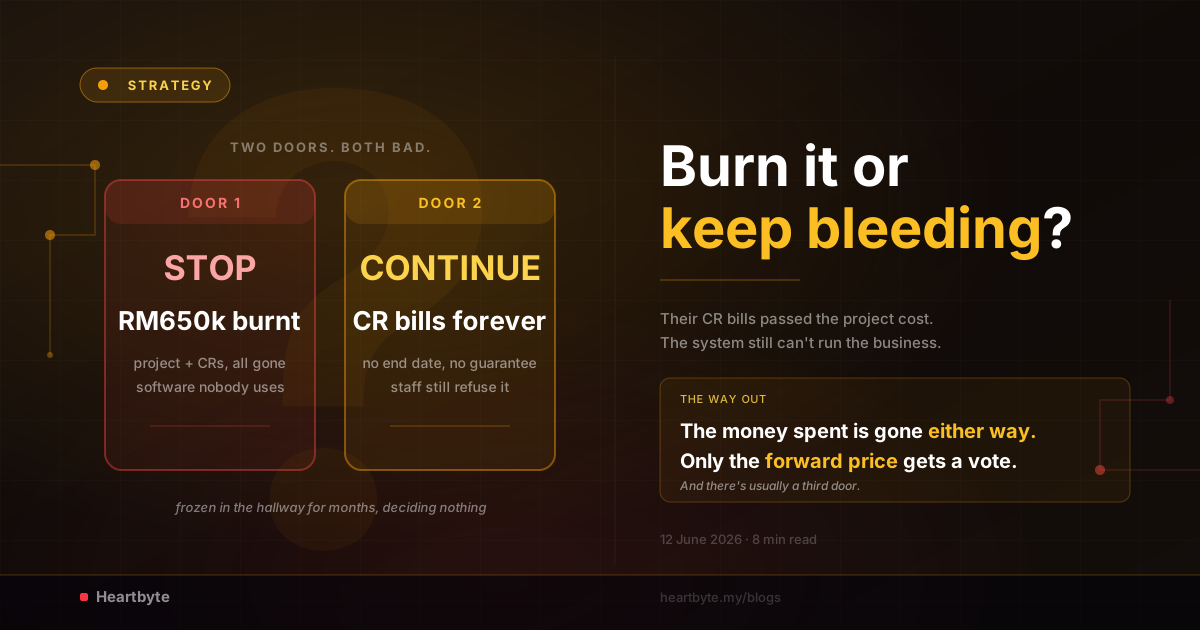
- ▸ Door one: stop. Walk away from the system. Everything spent so far — project plus CRs — is burnt. RM650k for software nobody uses.
- ▸ Door two: continue. Keep paying CRs to a vendor whose pricing already doubled the project. No fixed end date. No guarantee the staff will ever accept it.
- ▸ Meanwhile: the daily work still runs on manual patches, staff morale keeps dropping, and every month of "deciding later" costs real money too.
Walk away and you burn everything you've spent. Keep going and the bills keep coming. So they did what most companies do when both doors look bad. They stood in the hallway and did nothing.
The money you spent is gone either way
The first thing we told them is uncomfortable but true: the RM650k is gone. It was gone before they called us. Whether they continue or stop, no decision brings it back.
That sounds brutal, but it's actually the key that unlocks the whole decision. The reason they couldn't choose is that they were trying to "save" money that was already spent. Continue, and the old spending feels justified. Stop, and it feels wasted. So every meeting turned into a debate about the past instead of the future.
"The only question that matters now: starting from today, which path gets you a system your staff will actually use, for the least money? Everything spent before today shouldn't get a vote."
Once you frame it that way, the decision stops being emotional. You're no longer deciding whether the last two years were a mistake. You're comparing two forward prices, and forward prices can be calculated.
How does a sensible company end up here?
Nobody made one big stupid decision. That's what makes this trap so common. It's built from small, normal-looking steps.
The sign-off was based on a spec document, not on real daily work. We've written before about how UAT often protects the vendor more than the client. Passing UAT means the system matches the document. It says nothing about whether the document matched the business.
The staff who'd use the system every day were never in the room when it was scoped. So the gaps only showed up after go-live, when every gap had become a billable item. That's the CR business model working as designed: quote low, win the project, and earn the real margin on every change the spec conveniently missed.
And when staff push back on a half-working system, it's rarely stubbornness. It's usually because the system makes their day harder, not easier. We covered that in why employees resist new systems. Force adoption of software that creates manual work and you don't get adoption. You get quiet sabotage and Excel.
What we actually told them to do
The good news, and we mean this seriously: it's almost never a true all-or-nothing choice. "Burn it or keep bleeding" is how the trap presents itself. It's rarely the real set of options.
The way out, step by step:
- ✓ Audit what you actually own. The database, the working modules, the infrastructure, the cleaned-up business rules. In most "failed" systems, a big chunk still has real value. You're rarely starting from zero.
- ✓ Map the manual work, not the feature list. Sit with the staff and list every workaround they do in a week. That list is the real spec. It's usually much shorter than the CR backlog.
- ✓ Price both paths forward-only. Cost to fix what exists versus cost to rebuild the broken parts on top of what's salvageable. Ignore everything already spent. Now it's a maths problem, not a guilt problem.
- ✓ Change the deal, whoever does the work. No more open-ended CRs. Fixed outcomes, staff sign-off on real workflows, and a partner paid to make the system used — not paid per change. We've written about the difference that makes.
In their case, the audit changed everything. The data model was solid and two of the core modules worked fine. What was broken was the workflow around them. The realistic fix was a fraction of the vendor's endless CR road, and far cheaper than a full rebuild. The "impossible decision" disappeared once the third option was on the table.
How to never reach this point
If you're at the start of a project instead of the end of one, this whole story is avoidable. A few rules go a long way.
Put the actual users in the room before anything is signed. Not just the boss — the clerk who'll key in orders at 9am every day. Scope by outcome ("invoicing runs end to end without Excel") instead of by feature list, because feature lists are where manual work hides. Phase the project small, so a wrong turn costs you one phase, not the whole budget. And read the CR clause in the contract like it's the most important page, because for the vendor's finance team, it is.
Most of all, watch the early signals. CR invoices arriving monthly. Staff "temporarily" back on spreadsheets. A growing list of things the system "will handle in phase two". Companies don't fall into this trap suddenly. They walk into it slowly, one signed CR at a time, and the cheapest moment to turn around is the moment you first notice.
"Nobody ends up RM650k deep in one day. They get there one reasonable-sounding invoice at a time."
The honest version
This is the situation we never want a business to reach. Not because rescue work is hard — we do it, and it usually goes better than the client fears. But because almost all of that pain was avoidable, and the money that bought it could have built something the staff actually wanted to use.
If you're already in the hallway staring at those two doors, don't pick either one yet. Get an independent pair of eyes on what you actually own first. And if you're only halfway there, with the CR invoices stacking up and the grumbling getting louder, that's not background noise. That's the alarm going off early, while turning around is still cheap.
Stuck between burning it and keep bleeding?
We'll look at your system the way we looked at theirs: what's worth keeping, what it really costs to fix, and what the forward-only numbers say. No CR meter running. Just an honest answer before you sign another invoice.
Get an Honest Second OpinionHeartbyte Team
Heartbyte is a bespoke software development company based in Malaysia. We build web, mobile, and custom software for ambitious businesses — and we rescue projects that other vendors left half-done.