

Does Your Data Tell a Story? If It Does, the Next AI Wave Will 10x You.
Everyone has data. Almost nobody has data that tells a story. The coming AI wave doesn't act on rows, it acts on the story behind them. If yours connects cause to outcome, you're about to pull away from everyone still sitting on disconnected spreadsheets.
Heartbyte Team
Engineering & Strategy
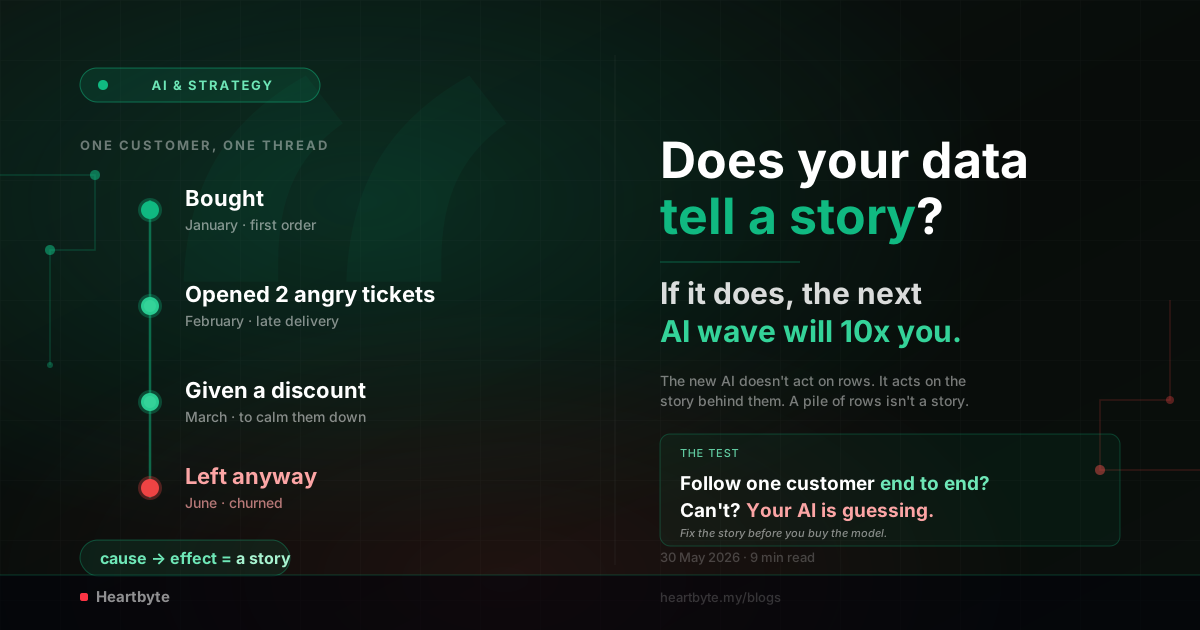
Every business owner I talk to says the same thing these days. "We want to use AI." Good. So I ask one question back. Does your data tell a story? And most of the time the room goes quiet. Because what they have is a pile of rows. And a pile of rows is not a story.
Here's a simple test you can run in your head right now. Pick one customer. Can you follow them through your data from the first day to today? What they bought, when they complained, what you did about it, whether they came back? If you can follow that thread, your data tells a story. If you can't, you've got data that records things but explains nothing.
"AI doesn't get smart from data. It gets smart from data that tells it what happened, and why."
A pile of rows is not a story
Most business data is a stack of snapshots. Sales sit in one table. Support tickets in another tool. Stock levels in a third. Each one is true on its own. None of them are joined up. So you can see what happened, but you can never see why it happened.
A story has cause and effect. A customer waited three weeks for a delivery, opened two angry tickets, got a small discount to calm down, and left anyway four months later. That chain is a story. Your data probably holds all four of those facts. The problem is they're sitting in four different places, and nothing connects them. Nobody, and no AI, can read a story that was never written down in one piece.
This is why so many companies feel data-rich and insight-poor at the same time. They're not short on numbers. They're short on the thread that ties the numbers together.
The AI trend is changing, and that's the whole point
Most people still think of AI as a chatbot. You ask, it answers. Useful, but it's just talk. The wave coming now is different. It's AI that acts. People call them agents. Instead of telling you "this customer looks like they might leave," it does something about it. It flags the account, drafts the win-back email, reorders the stock before you run out, reroutes the late order to a faster courier.
That's a big jump. An agent isn't answering a question, it's making a move on your business. And a move is only as good as what the agent can learn from. To act well, it needs to see how the same situation played out the last hundred times. That history is the story. Give it the story and it acts like your sharpest manager. Give it disconnected rows and it's guessing with confidence, which is the worst kind of guessing.
"A chatbot can survive on messy data. An agent acting on your business can't. The new AI raises the price of bad data instead of hiding it."
What "10x" actually looks like
When your data tells a story, the new AI stops being a toy and starts paying for itself. Not because the model is clever, but because it can finally see the patterns your best people learned over years, and apply them to every customer at once, all day, without getting tired.
What story-data unlocks
- ▸ It can predict. "This account looks like 200 others that churned. Here's the one we should call today."
- ▸ It can recommend the next move. "Last time this happened, the refund kept them. The discount didn't. Do the refund."
- ▸ It can run the boring decisions for you. Auto-approve the safe orders, hold the risky ones, reorder stock before it runs dry.
- ▸ It gets better the more it runs, because every action becomes one more chapter in the story it learns from.
That's where the 10x comes from. One good manager spots a pattern after seeing it a hundred times. AI with a clean story spots it across your whole customer base in a second, and never forgets. The company that feeds it a real story grows on rails while everyone else is still pulling reports by hand.
Most companies' data can't tell a story, and they don't know it yet
We've made the first half of this point before. We wrote that without data, your AI has no edge, that it can only spit out the same generic answer as everyone else using the same tools. This is the next layer of that problem. Even when a company does have plenty of data, it usually still can't tell a story, because the pieces don't connect. The sale doesn't link to the support ticket. The ticket doesn't link to the refund. The refund doesn't link to the customer walking away.
We've also seen how a system can show green numbers all day and still be useless. Same disease here. Your dashboards can look healthy while your data fails to explain a single thing. And the day you point modern AI at it, that gap stops being invisible. The AI does what your data lets it do, which is not much.
A quick test: does yours actually tell a story?
You don't need a consultant to find out. Try answering these from your data alone, without asking a person to dig around:
Ask yourself, honestly:
- ✓ Can you follow one customer end to end? First touch, every order, every complaint, today's status, all from one place.
- ✓ For any outcome, can you see what led to it? A churn, a big sale, a refund, can you trace the steps before it?
- ✓ Is the "why" recorded anywhere? Why the discount, why the cancel, why the late ship. Or do you only store the "what"?
- ✓ Are your systems connected? Or is every real answer a manual export-and-merge job in Excel at month end?
If most of those are a "no," your data doesn't tell a story yet. That's not a disaster. It's the most valuable thing you can fix right now, and it's worth fixing before you spend a cent on any AI tool.
So what does a sane company do?
The fix is boring, and no bigger AI model will do it for you. It's plumbing. Connect the systems so a customer is one thread instead of five disconnected records. Start capturing the why next to the what, even if it's a single dropdown reason on a refund. Record the decisions you make and what happened after, so there's something to learn from later.
Where to put your effort, in order:
- ✓ Join the dots first. One customer, one timeline. If your sales, support, and delivery data can't see each other, that's job one.
- ✓ Capture the why, not just the what. The reason behind an action is the most useful column you're probably not saving.
- ✓ Keep the outcomes. What you did and what happened next. That pairing is what turns history into a lesson the AI can use.
- ✓ Do this before the AI spend. The model is cheap and getting cheaper. The story is the part nobody can sell you. It's your moat.
This is the unglamorous work we push clients toward before anyone says the word "AI." Get the story straight, and the AI part becomes almost easy. Skip it, and no model on earth will save a project built on rows that don't connect.
The honest version
The coming AI wave is going to split companies into two groups. The ones whose data tells a story will pull away fast, because the AI finally has something real to learn from and act on. The ones sitting on disconnected rows will keep getting generic output, keep wondering why their "AI project" did nothing, and keep blaming the tool.
The gap won't show for a while. Both groups will look fine for a year or two. Then one day the company that fixed its data is making a thousand smart calls a day on autopilot, and the other one is still arguing about which spreadsheet is the real one. By then it's a very expensive gap to close.
"Buying AI before your data tells a story is like hiring a genius and handing them a shredded file. The smarter they are, the more obvious it is they've got nothing to work with."
Want your data to actually tell a story before the AI wave hits?
We help businesses connect their systems, capture the why behind the what, and build the kind of data the next generation of AI can actually use. Get the foundation right, and the growth takes care of itself. Let's talk.
Talk to Us About Your DataHeartbyte Team
Heartbyte is a bespoke software development company based in Malaysia. We build web, mobile, and custom software for ambitious businesses, and we get their data in shape so the AI they buy next actually has something to work with.