
"I Can Build It With AI Myself"
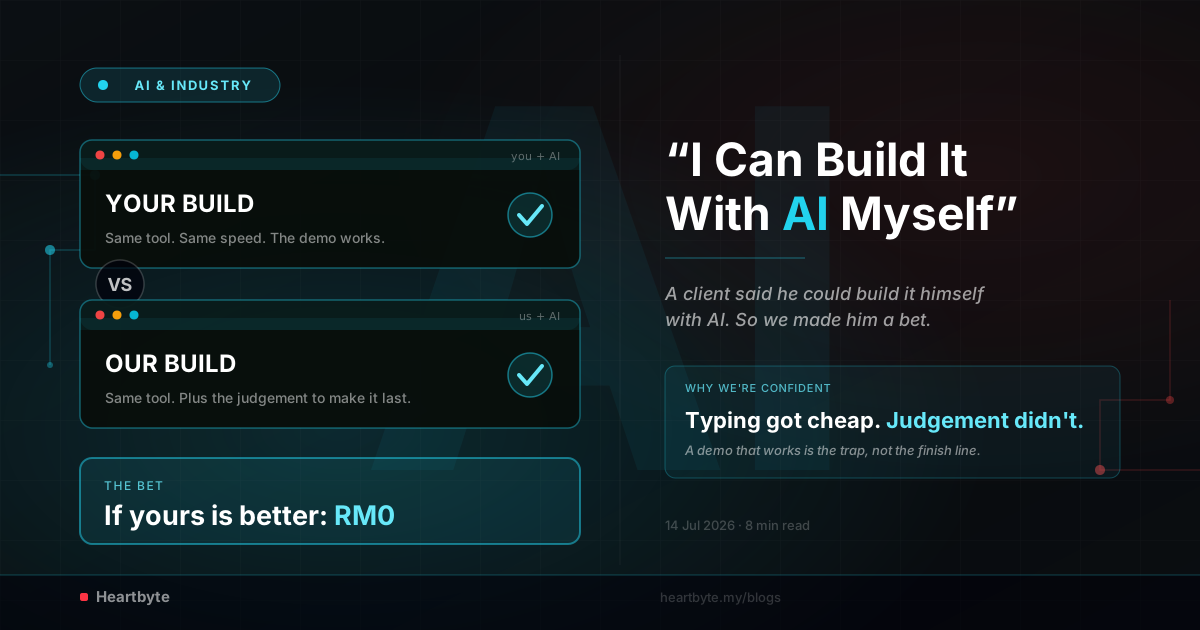
A client said it to my face. AI can build now, so why pay us so much? Fair question. So I gave him an offer instead of an argument. Build it yourself. We'll build the same thing with AI too. If yours is better, you don't pay us a cent.
Heartbyte Team
Engineering & Strategy
A client said it to my face last month. "I can build this myself now. I've got AI. Why am I paying you so much?" He wasn't being rude. He meant it. And honestly, he's half right. AI can build. He can sit down tonight, describe what he wants, and watch working screens appear in an hour. That used to take my team a week.
So I didn't argue with him. Arguing sounds like a salesman protecting his fee. I gave him an offer instead.
"Go build it. Really build it. We'll build the same thing with AI too, side by side. If yours comes out better, you don't pay us a cent."
He went quiet. Then he asked the question everyone asks. "How can you afford to say that?" Easy. Because the part he thinks he's buying and the part he's actually buying are two different things.
His question is fair, so let's take it seriously
For years, software felt expensive because typing code was slow and only a few people could do it. You paid us partly for that. Someone had to sit there for weeks turning your idea into working screens, and that time cost money. Fair enough. That was real.
AI changed that part. Now the typing is fast and nearly free, for you and for us. My client saw that and drew the obvious line: if the slow expensive part just got cheap, my bill should get cheap too. I get why he thinks that. He's watching the exact thing that used to cost a fortune happen in front of him for the price of a subscription.
But he's measuring the wrong thing. He thinks he paid us to type. He didn't. He paid us to know what to type, to catch what the typing got wrong, and to build something that still stands up after real people start using it. AI made one of those cheap. It made the other two more valuable, not less.
Why I can make that bet with a straight face
Here's what most people miss. When my client builds with AI, and when my team builds with AI, we're both using the same tool. Same models. Same speed. The AI doesn't type faster for me because I run a software company. So on raw building speed, we're dead even. He's right about that.
The bet isn't "we can build and you can't." The bet is "we both build, and mine holds up under pressure and yours doesn't." I'm not betting on typing. I'm betting on everything the AI can't do for you: knowing which of its answers is quietly wrong, spotting the security hole it left open, handling the ten edge cases it forgot, and building it so next year's change doesn't mean starting over.
What AI gave both of us equally
- ▸ The typing. A working first draft in an hour. Same for you, same for us.
- ▸ The confidence. The screen looks done, so it feels done. That feeling lies to everyone the same way.
What it didn't give you
- ▸ The judgement to know when it's wrong. The AI is confident whether it's right or not. You need to tell the difference.
- ▸ The scars to know what breaks later. The stuff that only bites you three months in, once real data and real users show up.
The demo works. That's the trap.
When you build with AI, the first version looks amazing. It really does. Buttons work, data saves, it looks like the real thing. And that's exactly the moment people stop and say "see, I built it myself." We've written about this before: it looks like it works, so they commit. The demo passing is the start of the hard part, not the end of it.
Because a demo only has to survive you clicking through it once, the nice way, on your laptop. Real software has to survive a hundred people using it wrong, all at the same time, on bad internet, with messy data, doing things you never imagined. That's where the AI's first draft quietly falls apart. Two users editing the same record. A customer with an apostrophe in their name. A file too big to upload. A total that's off by one cent and nobody knows why.
None of that shows up in the demo. All of it shows up in month three, usually on the day it matters most.
"AI builds the software that works when you're careful. We build the software that works when everyone else isn't."
The AI is confident, not correct
This is the part that catches everyone. When the AI gets something wrong, it doesn't look wrong. It looks just as polished and sure as when it gets things right. It'll happily write code that leaks your customer data, or lets a user see someone else's orders, or drops a payment on the floor, and it'll present all of it with the same calm confidence as the stuff that actually works.
To catch that, you have to already know what right looks like. That's the whole job. AI rewards the people who can already solve the problem, because they can steer it and check it. Hand the same tool to someone who can't, and it cheerfully helps them ship the wrong thing faster, looking great the whole way. You won't find out until a customer does.
So when you build it yourself, you're not just doing the building. You're also the only person checking the work, and you're checking it against knowledge you don't have yet. That's not a knock on you. It's just not your job to have spent ten years learning where software hides its landmines. It's ours.
So what does "better" actually mean?
When I make the bet, we agree on what "better" means up front, because "it looks nicer" isn't it. Better means it holds up. Same features, but run both through the same real test and see which one survives.
The test we'd actually run on both builds:
- ✓ Throw real, messy data at it. Not the three clean rows from the demo. A thousand ugly real ones.
- ✓ Let a stranger try to break it. Can they see data that isn't theirs? Get in without logging in? Crash it on purpose?
- ✓ Run your real workflow, not the happy path. The refund, the cancellation, the weird approval nobody wants to talk about.
- ✓ Change something big. Then see which build bends and which one needs a rebuild.
Both builds look identical on day one. The gap only shows up when you push on them. That's the whole point of the bet. I'm not asking you to trust that we're better. I'm asking you to find out, for free.
Why the offer is real, not a sales trick
A "money back if you're not happy" line is usually noise. This isn't that. I'll put it in writing. If your AI build passes the same test ours does, keep your money and keep your build. I mean it, and I can mean it because of simple maths.
AI made building cheap for us too. Our cost to produce the competing build isn't what it was three years ago. So the bet costs me a bit of my team's time, not a fortune. And the times we'd lose the bet are the times you genuinely didn't need us, which means we shouldn't have taken your money anyway. I'm happy to lose those. The rest of the time, you get to see the difference with your own eyes before you spend a cent. That's a better sales pitch than any argument I could make about why we're worth it.
"If we can't build it clearly better than you can with the same AI, we haven't earned the fee. Simple as that."
What we're really selling now
The old business was "we can build, you can't." That business is dead, and good riddance. AI killed the part where you paid us just because typing code was a locked room only we had the key to. Everyone can open that door now. We're glad. Everyone can build now, and that's a good thing.
What's left is the part that was always the real work. Knowing what to build so it fits your business instead of fighting it. Catching the AI when it's confidently wrong. Building it so it survives real users and next year's changes. Code got cheap. Software didn't. The typing was never the expensive part. It just used to be the visible one.
So when a client tells me he can build it himself with AI, I don't get defensive. I agree with him. Then I bet my fee that "built" and "built to last" are still two very different things, and that the gap between them is exactly what he was paying us for the whole time. He just couldn't see it, because the typing was in the way.
The honest version
If you can build it with AI and it holds up under real pressure, please do. Keep your money. You genuinely don't need us, and I'm not going to pretend otherwise to win a fee. That's the whole reason we can make the offer at all.
But most of the time, the thing you build in an hour and the thing your business can actually run on for years are not the same thing, no matter how good the demo looks. We're happy to prove that the only way that counts. You build yours. We build ours. If yours wins, you don't pay. We're that sure the part you were worried about paying for was never the part that was hard.
"You can build it with AI. So can we. The bet was never about who can build. It's about whose build is still standing a year from now."
Think you can build it yourself with AI? Good. Let's put both builds to the test.
Bring us something you've already built with AI, or something you're about to. We'll build the same thing and run both through the same real test. If yours holds up better, you don't pay. That's the offer.
Take the BetHeartbyte Team
Heartbyte is a bespoke software development company based in Malaysia. We build web, mobile, and custom software for ambitious businesses, using AI heavily and putting real engineering judgement behind it so what we ship actually holds up.