

Why Most Digital Transformation Projects Fail (Before They Even Start)
The consultants were hired. The budget was approved. The vendor was picked. Six months later nothing works, and everyone's already pointing fingers.
Heartbyte Team
Engineering & Strategy
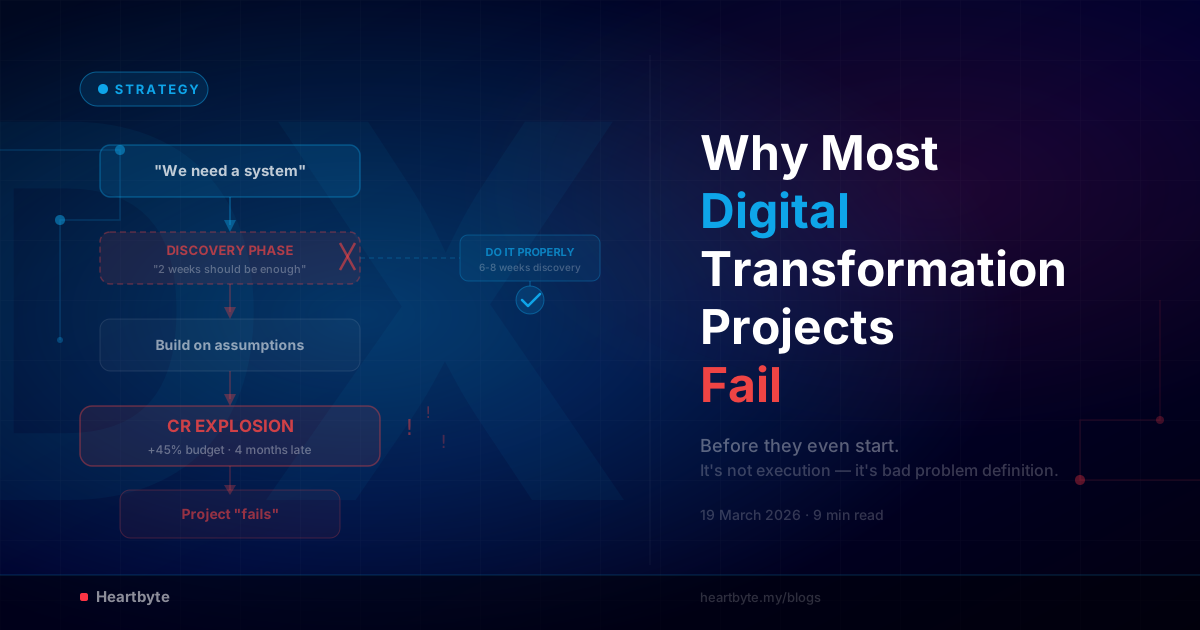
"Digital transformation" is one of the most overused phrases in business. Every vendor promises it. Every board wants it. Every competitor claims they've already done it. But study after study shows the same thing: most of these projects fail.
Most post-mortems miss the real reason. These projects don't fail while you're building them. They fail before anyone writes a line of code. The cause is rarely bad technology or bad developers. The problem was usually badly defined from the start.
Companies Jump Into Tools Before Fixing Processes
The most common pattern we see is a company deciding they "need a system," then jumping straight to picking a vendor. They start looking at ERPs, CRMs, custom platforms, and SaaS products before they've done the hard work of figuring out what's actually broken.
This is the tool-first trap. They assume technology will fix the problem. But if the process underneath is broken, no software will save you. Say approvals take three weeks because of internal politics. Say data is scattered across five departments because no one owns it. Say complaints fall through the cracks because there's no clear workflow. All you've done is make a mess run faster.
Automating a broken process doesn't fix it. It just makes it break faster and at scale.
A company that moves inventory through four spreadsheets, two email chains, and a WhatsApp group doesn't need "inventory management software." They need to map how the work really flows, find where it breaks, and fix the process first. Then they can build or buy a tool that supports it.
Skip this step and you end up with an expensive system nobody uses. The tool was never the problem. The workflow underneath it was.
Management and Operations Are Solving Different Problems
In most companies, the people who approve the budget aren't the people who'll use the system every day. That gap poisons the whole project.
The two versions of "what we need":
Management says:
"We need a unified dashboard. Real-time analytics. KPI tracking. Executive reporting. Mobile access. AI-powered insights."
Operations says:
"We need to stop entering the same data into three different systems. We need the approval process to not take two weeks. We need to find customer records without calling four people."
These are two different problems. Management is buying visibility. Operations needs to get the work done faster. Build the system around management's wishlist of dashboards and reports, and ignore the daily friction operations deals with, and you can guess what happens. The operations team fights the new system, works around it, or slips back to their spreadsheets.
If your project doesn't start with the people doing the actual work, you end up with an expensive reporting tool that nobody feeds good data into.
"The executives got their dashboard. The warehouse team still uses WhatsApp to track deliveries. Both sides think the project was a failure."
"We Need a System" Is Almost Never the Right Starting Point
When a company says "we need a system," what they usually mean is "something is slow and we want technology to fix it." That's a fair instinct. But jumping from "something is wrong" straight to "we need software" skips the most important question: what's actually wrong?
Sometimes the problem is your process
If your sales team can't close deals fast, it might not be because you lack a CRM. It might be because quoting needs three levels of approval, your pricing sheet hasn't been updated in six months, and nobody knows who's supposed to follow up on proposals. A CRM won't fix any of that.
Sometimes the problem is people
Sometimes the bottleneck is one person who sits on information, a team that won't share data, or a manager who insists on approving every small decision. Software can't solve office politics. If you don't sort out the people problem first, the new system just inherits the same mess.
And sometimes it's just communication
"We need better reporting" often just means "we need people to talk to each other." When sales doesn't know what operations promised, finance doesn't know what sales quoted, and support doesn't know what was delivered, a dashboard won't save you. You need a workflow that gets the right information to the right people at the right time.
None of this means systems are pointless. You often need them. But a system built on the wrong diagnosis fails, and it fails expensively. Getting the diagnosis right is the best money you'll spend on the whole project.
The Discovery Phase Gets Rushed, and Everything Pays for It
Every software project has a phase called "discovery." This is where the team maps the processes, talks to the people involved, finds the pain points, and works out what the system needs to do. It's the most important phase, and it's the first one to get cut.
Why? Because there's nothing to show for it. No login screen to demo, no dashboard to screenshot, nothing to put on a progress bar for the board. Discovery feels like "talking," and companies want to see "building."
What happens when discovery is rushed:
Requirements are vague or incomplete — the team builds what they think you asked for, not what you actually need. Edge cases, exceptions, and real situations get missed.
The right people weren't asked — the ones who use the system every day never got interviewed. Their workflows, their pain points, and what they actually need are all missing from the spec.
Scope gets locked too early — the project starts with a fixed scope based on a half-formed picture. When reality shows up mid-build, every change becomes a change request.
Change requests explode — this is the big one. When discovery is thin, the gap between what was specced and what's actually needed shows up during the build. Every gap turns into a CR. Every CR costs money and pushes the timeline back.
We've seen projects where the change request bill ended up bigger than the original quote. The vendor wasn't ripping anyone off. The spec was just built on guesses instead of real research, because discovery had been a two-week box-ticking exercise instead of a proper look at the business.
A rushed discovery phase doesn't save time. It just shifts the time and cost into the most expensive part of the project: mid-build rework.
The CR Explosion: Where Budgets Go to Die
If you've read our earlier pieces on change request fees and how hidden CR fees kill IT projects, you'll know this pattern. It's worth repeating here, because this is where the two problems meet.
A weak discovery phase gives you a half-baked spec. A half-baked spec gives you a system that doesn't match how the business really works. Then your team starts testing and finds the holes: "wait, this doesn't handle partial deliveries," "where's the approval for credit notes?", "this report is missing the data we actually need." Every one of those fixes gets logged as a change request.
The CR cascade in practice:
Original quote: RM 150,000 for a custom operations platform
Discovery phase: 2 weeks, surface-level interviews, no process mapping
Build starts: development team works from a spec that looks complete on paper
UAT begins: operations team tests the system and finds 30+ gaps in workflow coverage
CR avalanche: 22 change requests logged, totalling RM 68,000 in additional work
Final cost: RM 218,000 — 45% over budget, 4 months behind schedule
This isn't made up. It's what normally happens when discovery is treated as a formality. The vendor isn't always to blame. They built what the spec said. The spec was just wrong, because nobody took the time to get it right.
What a Proper Digital Transformation Actually Looks Like
The projects that work, the ones that really change how a company runs, do it a different way. They spend the time upfront so they don't pay for it later.
Start with process, not technology
Before you look at any software, map how the work flows today. Where does data come into the business? Where does it get stuck? Where are the manual steps and the handoffs that slow things down? What would the ideal process look like, no matter what tool runs it?
Talk to the people who do the work
Not just managers or department heads. The people on the ground: warehouse staff, customer service reps, the finance officers handling invoices every day. They know where the real problems are, and they'll tell you if you ask them.
Align management and operations on the same problem
Before writing a single requirement, get both sides in the same room. What does management need? What does operations need? Where do the two overlap or clash? Sort out the conflicts before the build starts, not during UAT, when every disagreement turns into a CR.
Invest in discovery like it's the project
A proper discovery phase should take 4–8 weeks, not 2. It should give you process maps, user journeys, a ranked list of requirements, and a clear scope both sides have signed off on. That's not wasted time. It's the base everything else sits on.
"We spent eight weeks on discovery and people thought we were wasting time. Then we delivered the full system in five months with zero change requests. The eight weeks paid for themselves ten times over."
Treat It as a Business Project, Not a Tech One
Digital transformation is really a business project that happens to use technology. That matters, because it changes where you put your time, money, and attention.
Treat it as a tech project and you'll burn the budget on tools, licences, and dev hours. Treat it as a business project and you'll spend that budget on understanding the problem first. That makes the tech part much cheaper and much more likely to work.
The cost difference is stark:
Rushed Discovery
Proper Discovery
The maths is simple. A few extra weeks of discovery saves you months of rework, tens of thousands in change requests, and the biggest cost of all: a system nobody uses.
Fix the Operation First, Then Go Digital
The companies that get this right don't start with technology. They start with an honest look at what's broken, why it's broken, and what "fixed" actually looks like for the people doing the work every day.
They don't rush into picking a vendor. They spend money on understanding before they spend it on building, and they get management's vision lined up with what operations deals with on the ground. For them, discovery isn't a cost to cut. It's the most valuable part of the whole project.
If your project is about to start, or has already stalled, ask yourself one thing: did you define the problem before you started solving it? If the answer is no, the smartest thing you can do right now is stop building for a while and go listen to your own team.
Ready to do digital transformation properly?
We start every project with proper discovery. We map your processes, talk to your team, and build the right thing from day one. No rushed specs. No CR surprises.
Talk to Us About Your ProjectHeartbyte Team
Heartbyte is a bespoke software development company based in Malaysia. We build web, mobile, and custom software for ambitious businesses — with 15+ years of combined engineering experience and zero change request fees, guaranteed.