
AI Got You Hooked. Now Comes the Bill.
For two years AI felt almost free. Generous limits, cheap plans, everything included. Now the credits run out by the third week, the quota on the plan you already pay for got smaller, and your renewal quote has an AI line on it that nobody can explain. That wasn't a glitch. That was always the plan.
Heartbyte Team
Engineering & Strategy
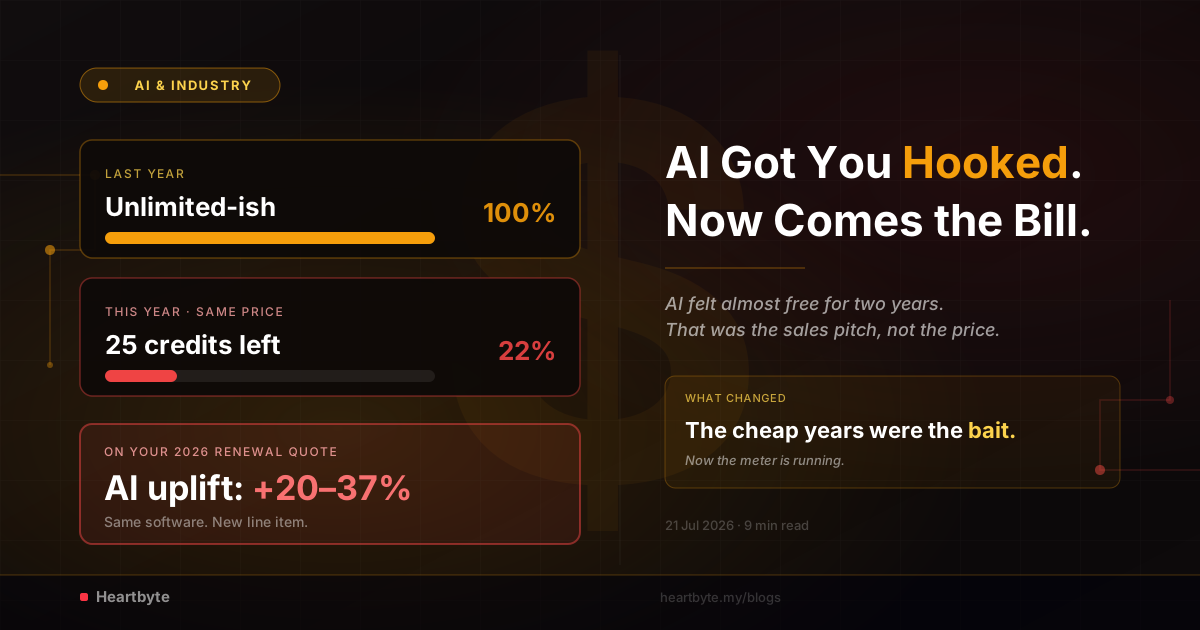
Most business owners we talk to had the same experience this year. AI showed up in the tools they already use. It was fun, it worked, staff started using it daily. Then the renewal came round and the number was 30% higher, with a new line item about AI that nobody in the company could properly explain.
You're not imagining it. AI uplifts of 20 to 37 percent are turning up on 2026 software renewal quotes. Software vendors as a whole are pushing prices up around 12% a year, close to five times general inflation. The cheap era is closing, and it's closing fastest for the people who got most attached to it.
"The first hit was cheap because they needed you hooked. Nobody spends billions on data centres to run a charity."
The cheap years were the sales pitch
Every AI company spent the last two years fighting for the same thing: your habit. Get you using it daily, get it wired into how your staff work, get your business leaning on it. Price was a weapon in that fight, not a reflection of what the thing costs to run.
Meanwhile the bills behind the scenes are enormous. The big cloud providers are putting something like $600 billion into AI infrastructure this year. Top-end chips have waiting lists close to a year. That money has to come back from somewhere, and there's only one place it can come from. You.
So the pattern is the same one you've seen before with ride-hailing apps and food delivery. Cheap while they're buying the market, then the real price once you've reorganised your life around it. AI is at that turn now, except this time you didn't just get used to cheap taxis. You built your workflow on it.
Credits: a currency you can't count
The bigger change is how you're charged. Software used to be simple. One seat, one price, one number in the budget. Now it's credits, and credits are deliberately hard to reason about.
Atlassian gives you 25 AI credits per user each month, then charges around $0.30 per extra conversation. HubSpot sells credits at roughly $10 per thousand once your allowance is gone. Zendesk charges about $1.50 for each conversation its AI resolves. Adobe's credits reset every month and don't roll over, and different features eat them at different rates.
Here's the problem with all of it: you can't tell what a task will cost before you run it. Your staff certainly can't. So people either use it freely and blow the allowance, or get nervous and stop using the thing you're paying for. Both are bad, and neither is an accident.
Why credit pricing feels slippery
- ▸ No price tag before you click. One request might cost a credit. A big one might cost forty. You find out afterwards.
- ▸ Credits don't roll over. Unused ones expire, but going over costs you cash. The house wins both directions.
- ▸ The exchange rate moves. What a credit buys is set by the vendor and can quietly change.
- ▸ You can't compare vendors. Credits, tokens and per-action pricing don't translate, so nobody can shop around properly.
Your plan is shrinking while the price stays the same
The quieter move is what happens inside plans you already have. API call caps come down. Storage allowances shrink. AI credit allocations get trimmed. Same monthly price, less in the box.
Supermarkets have been doing this for years and there's a word for it. The packet looks identical, it just weighs less. Software vendors have worked out they can do the same, and because AI limits are complicated, most customers never notice until something stops working mid-month.
Watch what actually happens then. Work stops. Somebody in your team hits a wall on a Tuesday afternoon, and now you're choosing between paying an overage on the spot or telling staff to go back to doing it by hand. Vendors know this, which is why the wall exists.
"Same price, smaller packet. The old supermarket trick, moved into your software renewal."
AI agents burn money far faster than chatbots
There's a technical reason costs are climbing so fast this year, and it's worth understanding because it's not going to reverse.
When AI meant a chatbot, one question got one answer. Cheap and predictable. The tools everyone's excited about now are agents. They plan, they go and fetch things, they check their own work, they try again when they get it wrong. A single agent task can fire off ten to twenty separate requests behind the scenes and use many times the tokens of a simple question.
You pay for all of it, including the attempts that failed. Developers using AI coding tools have been loudest about this, watching a month's credits vanish in days once agent mode arrived. The same maths is coming to every AI feature in every tool you use, because agents are what every vendor is shipping next.
The pilot lies to you
This is the one that catches out serious companies, and it's the most expensive mistake on the list.
A vendor gives you a pilot with generous credits. Small team, light use, everyone's impressed. You take the numbers from that pilot and multiply by however many staff you have. That's your business case, and it looks great.
Then you go live and the real number lands somewhere between five and ten times your estimate. Not because anyone lied, but because real use looks nothing like a pilot. People run bigger jobs, they retry things, they use it for work you never anticipated, and the heavy users turn out to be much heavier than the average suggested. AI-native software spend is up over 100% year on year across companies generally, and nearly 400% in large ones. Very little of that was in anyone's budget.
What's actually happening in 2026
- ▸ AI uplift on renewals: 20 to 37 percent added to 2026 quotes.
- ▸ Software prices generally: rising about 12% a year, roughly five times inflation.
- ▸ Pilot to production: real costs routinely land 5 to 10 times over the estimate.
- ▸ And the results: only around 29% of companies report a real return on their AI spend so far.
That last number is the one that should bother you most. Costs are climbing quickly and most companies still can't show what the money bought. We've said before that AI is worth very little without the data underneath it. This is the same lesson arriving as an invoice.
Where the waste usually is
Before you assume you're being ripped off, check how the AI in your business is actually built. Two companies doing the exact same work can have bills that differ tenfold, and the difference is almost always design rather than pricing.
The common ones we find: sending an entire document library to the AI on every single question, when two pages would do. Using the biggest, most expensive model for simple jobs like reading a date off an invoice. Never storing an answer, so the same ten questions get charged at full price a thousand times a day. Letting an agent loop with no limit, so a confused system can spin twenty times and bill you for every round.
None of that shows up in a demo. It shows up in month four, as a number nobody can account for. It's the same shape as ordinary technical debt, and it's the specific trap in "I'll just build it with AI myself". Getting an AI feature working is easy now. Building one that still makes financial sense at ten thousand uses a day is a different job.
What to actually do about it
Not "stop using AI". We use it heavily every day and it earns its keep. But the era where you could ignore the cost is finished, so treat it like any other real expense in the business.
Five things worth doing before your next renewal:
- ✓ Find out what one job costs. Not the monthly total. What does one processed invoice or one handled support ticket cost in AI? Without that you can't tell profit from waste.
- ✓ Read what your quota was last year. Compare it to what you get now for the same money. Vendors rarely announce a shrink.
- ✓ Negotiate the AI line separately. That 20 to 37 percent uplift is an opening offer, not a fixed price. Ask what happens to your rate if usage doubles, and get it in writing.
- ✓ Cancel the AI features nobody uses. Most companies are paying for three or four AI add-ons where staff genuinely rely on one.
- ✓ Own the important stuff. For a process that's core to how you make money, renting it by the credit forever is the expensive path. Building it properly gives you a cost you control.
That last point is the one most business owners haven't thought through yet. When AI was nearly free, renting made total sense. As prices climb and pricing models get slipperier, the sums change. If a process is central to your business and you're paying per action for it forever, you've handed someone else a permanent tax on your own operations, and they set the rate.
The honest version
AI is still one of the best things to happen to small and mid-sized businesses in a long time. The work it does is real. But the pricing you fell in love with was a promotion, and promotions end. What's arriving now is the actual price, spread across credit systems and quota changes and renewal uplifts that are hard to compare and harder to argue with.
The companies that come out of this fine won't be the ones that spent the least or panicked and cut everything. They'll be the ones who know exactly which AI they depend on, what it costs per job, and which pieces are worth owning outright. Everyone else finds out at renewal, when their negotiating position is already gone.
"Cheap AI got you to build your business around it. That was the point. Now they've got you, and the meter is running."
Paying more for AI every year with nothing to show for it?
We build AI into real systems and design them so the running cost still makes sense at scale, with the right model for each job, sane limits, and a cost per job you can actually point at. If your AI spend is growing faster than your results, let's talk.
Talk to Us About Your ProjectHeartbyte Team
Heartbyte is a bespoke software development company based in Malaysia. We build web, mobile, and custom software for ambitious businesses, using AI heavily and designing it so the running cost still makes sense a year later.